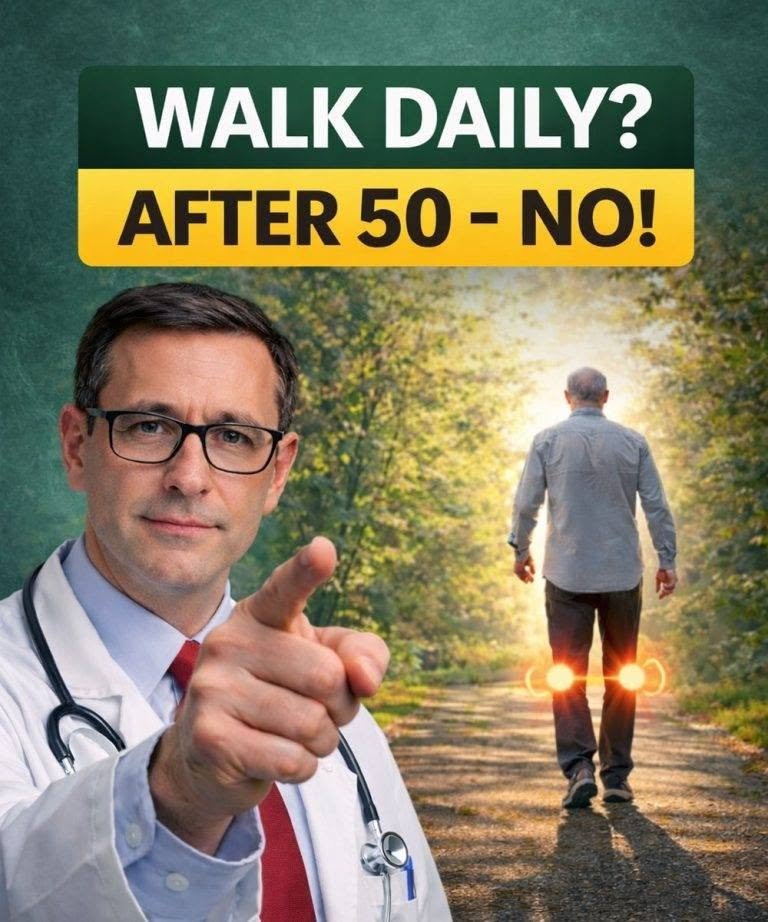
A doctor talking about “walking mistakes” after 50 isn’t fearmongering—it’s usually about preserving your joints, getting the full cardiovascular benefit, and preventing falls. The “mistakes” aren’t about doing something wrong in a social sense, but about biomechanics and safety that can turn a healthy activity into a source of injury.
Let’s decode the 7 mistakes that headline is likely referring to, with the real doctor-backed reasons and fixes.
The 7 Walking Mistakes (and a Doctor’s Real Advice)
1. The “Mall Walker” Stride (Overstriding)
This is the number one biomechanical error.
-
The Mistake: Taking steps that are too long, landing heel-first with a straight knee far out in front of your body. It feels like you’re going faster, but you’re actually slamming on the brakes with every step.
-
The Health Impact After 50: This sends a jarring shockwave straight up the leg into the knee, hip, and lower back. Over time, it contributes to hip bursitis, lower back pain, and wear-and-tear on the already-thinning cartilage of the knee joint.
-
The Doctor’s Fix: Shorten your stride and increase your cadence. Your foot should land almost directly under your body, not out in front. Imagine pushing the ground back with your glutes, not reaching forward with your foot. A faster, shuffling-feeling step is much safer.
2. The “T-Rex” Arm Swing (Or No Arm Swing)
-
The Mistake: Holding arms stiffly at the sides, bent at a 90-degree angle with hands dangling limply in front, or even worse, holding a phone or keys in one hand without moving the opposite arm.
-
The Health Impact After 50: Your arm swing is the counter-balance to your legs. Without a natural, forceful swing from the shoulders, your hips and lower back have to torque with every step to maintain balance. This wastes energy and causes unnecessary spinal rotation and strain.
-
The Doctor’s Fix: Think of your arms as pistons. Swing them from the shoulder joint, bending at the elbow to about 90 degrees, and pump them straight forward and back—not across your body. Your hand should travel from your hip to about chest height.
3. The “Walking Zombie” (Ignoring Arm and Back Strength)
-
The Mistake: Believing walking is only a leg exercise. Over months and years, a walker can develop strong calves and hamstrings but a very weak core and upper back.
-
The Health Impact After 50: This leads to a hunched, forward-head posture (kyphosis) that compresses the lungs and throws your center of gravity forward, dramatically increasing fall risk. You’re walking from your knees down, not from your powerful glutes and core.
-
The Doctor’s Fix: Don’t forget to swing your arms to engage your back. Consciously tighten your abdominal muscles to about 20% and imagine a string pulling you up from the crown of your head. Think “tall spine.” A physical therapist would tell you to also add dedicated upper body and core work on non-walking days.
4. Walking With Poles… Incorrectly
-
The Mistake: Using trekking poles to hunch over and tap the ground in front of you like a blind person’s cane.
-
The Health Impact After 50: Improper pole use reinforces a terrible hunched posture and loads the wrists and elbows incorrectly.
-
The Doctor’s Fix: Nordic walking, when done correctly, is arguably the single best walking upgrade after 50. The poles should be angled backward, and you push back against them to propel yourself forward, which engages the triceps, lats, and core. It turns walking into a full-body exercise and takes 30% of the load off your knees and hips. The posture is perfectly upright.
5. Staring at Your Feet (The “Fraidy Cat” Walk)
-
The Mistake: Looking down at the ground immediately in front of your feet, often driven by a fear of tripping.
-
The Health Impact After 50: This is a self-fulfilling prophecy. It throws your head’s 10-11 pounds forward, putting massive strain on your neck and upper back. More importantly, you can’t see obstacles coming in time to plan a safe path. You lose the visual horizon cues your brain needs for balance.
-
The Doctor’s Fix: Scan the ground 10 to 15 feet ahead of you. Your peripheral vision will alert you to immediate obstacles. Keep your chin parallel to the ground. This opens your airways, fixes your posture, and actually improves your body’s anticipatory balance.
6. The Always-Flat Route (The “Comfort Zone” Trap)
-
The Mistake: Always choosing a perfectly flat, paved, monotonous surface because it’s less tiring.
-
The Health Impact After 50: Your bones need varied, multidirectional stress to stay strong, especially for women after menopause. A flat surface only loads the same muscles in the same way, doing nothing for bone density in the hips and spine or for your crucial ankle stabilizing muscles.
-
The Doctor’s Fix: Choose a route with a gentle incline every so often. Even better, walk on a well-maintained grass or gravel path. The uneven surface forces tiny, automatic micro-adjustments in your ankles, knees, and hips, brilliantly strengthening all the small stabilizer muscles and stimulating bone building.
7. The “Sore Knee” Compensated Walk (Ignoring Pain)
-
The Mistake: When a knee or hip hurts, the natural reaction is to subtly change the gait to avoid pain—swinging the leg out to the side, limping, or shortening the step on the good side.
-
The Health Impact After 50: This is a recipe for creating a new injury on the other side of the body. A right-knee limp for a month will almost guarantee left-hip bursitis or lower back pain.
-
The Doctor’s Fix: Never “walk through” joint pain. Address the cause. A “gait analysis” from a physical therapist is the gold standard. They can instantly spot the compensation and prescribe the specific strengthening exercise (often for the hip abductors, not the knee itself) to get you walking evenly again.
The bottom line? Walking is one of the best medicines on the planet, but just like a prescription, the right dosage and technique matter. The doctor in that headline is likely saying: don’t just shuffle—walk with purpose, posture, and power.