
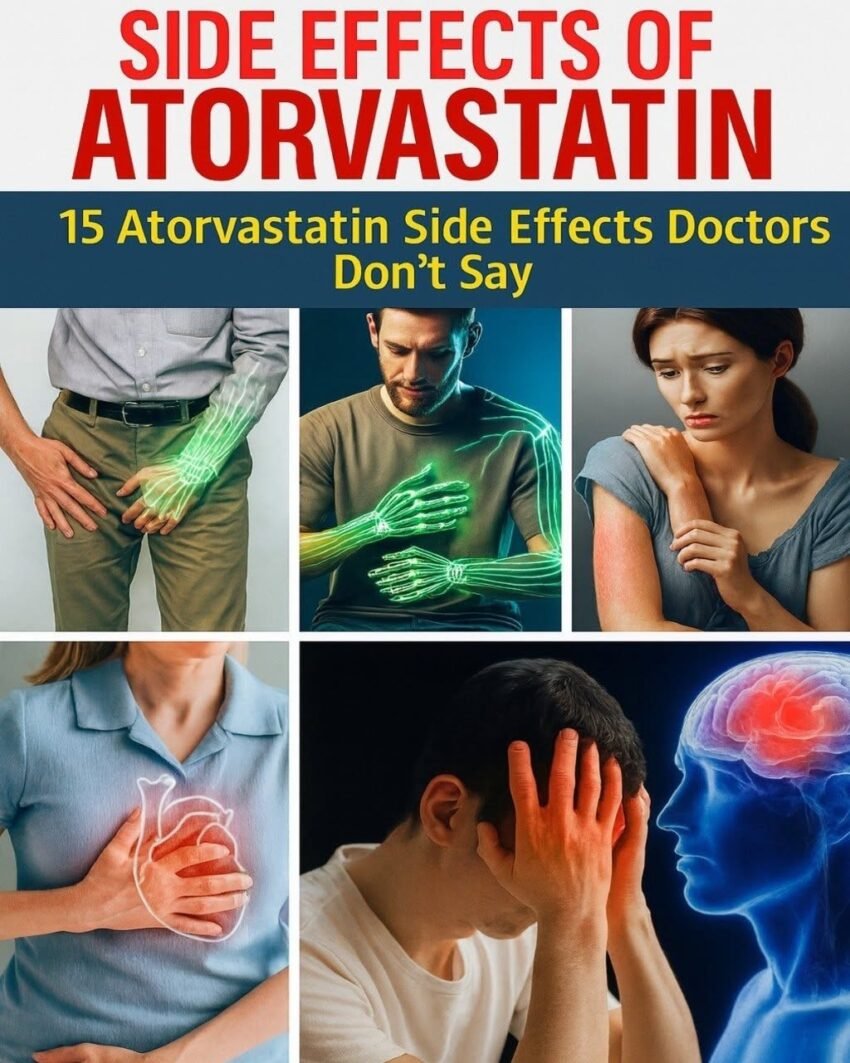
It’s important to clarify a key point upfront: the side effects of atorvastatin (Lipitor) are not “hidden” from the medical community, but in a busy clinical setting, the discussion often focuses more on the cardiovascular benefits than on the full patient experience. This can leave you feeling unprepared if a problem arises.
Here are 15 potential side effects and risks that often aren’t discussed in detail, organized from common but overlooked, to rare but serious.
Commonly Missed or Misattributed Effects
1. “Silent” Muscle Damage Without Pain
You might expect muscle pain, but some people experience persistent, unexplained fatigue and weakness without the classic aches. This can be a sign of a mild, chronic myopathy that only becomes apparent when you realize you can’t climb stairs or exercise as easily as before.
2. The “Brain Fog” Phenomenon
This isn’t just an occasional slip-up. Patients describe a significant clouding of consciousness, difficulty finding words, memory lapses, and a feeling of mental dullness that clears up when the drug is stopped. Because this mimics aging or stress, it’s often dismissed.
3. Significant Irritability and Mood Swings
While rare, clinically significant aggression, irritability, and quickness to anger have been reported. These mood changes are not the typical mild blues; they can affect relationships and are often only linked to the statin in retrospect after a “drug holiday” restores normal temperament.
4. Unmasking of Neuromuscular Disorders
Atorvastatin doesn’t cause ALS (Lou Gehrig’s Disease) or myasthenia gravis, but it can unmask them in someone who is genetically predisposed. If you experience progressive weakness (e.g., foot drop, trouble gripping) or drooping eyelids and double vision, this requires immediate neurologic investigation, not just a simple muscle ache check.
5. Tendon Pain and Rupture
Statins can disrupt the collagen structure in tendons. The key warning signs are a deep, aching pain in the Achilles or patellar tendon, sometimes with swelling (tendinopathy), which can precede a spontaneous rupture even without a major injury.
6. New-Onset Type 2 Diabetes
This is a well-established, dose-dependent risk. It’s most likely in people who already have pre-diabetes or metabolic syndrome. The “hidden” part is the slow creep of insulin resistance, where your HbA1c climbs 0.1-0.2% each year. This isn’t a dramatic event, but a gradual metabolic shift.
7. Persistent “Statin-Associated Myopathy” (SAM) After Stopping
While most muscle symptoms resolve after stopping, a subset of patients experience permanent necrotizing myopathy. Here, the body produces antibodies against its own muscle tissue. This is a distinct autoimmune disease triggered by the statin, requiring long-term immunosuppression. It’s not simply a side effect that fades; it’s a disease that stays.
Overlooked Nutrient Depletions
8. Coenzyme Q10 (CoQ10) Depletion
Atorvastatin blocks the same biochemical pathway (mevalonate pathway) that produces both cholesterol and CoQ10, a vital antioxidant for cellular energy. Your doctor may not mention that severe muscle pain and fatigue may be linked to this depletion, and while the data on supplementation is mixed, many lipidologists do recommend a trial of CoQ10.
9. Selenium and Other Trace Mineral Deficiencies
Statins may interfere with selenoprotein synthesis, crucial for antioxidant defense. An unrecognized selenium or zinc deficiency can mimic or worsen the muscle pain and fatigue of the statin itself.
10. Fat-Soluble Vitamin Depletion
A radical lowering of LDL particles, which transport fat-soluble vitamins like A, D, E, and K2, can theoretically lead to suboptimal levels. A hidden risk of Vitamin K2 insufficiency, in particular, is discussed in the context of statin-induced coronary artery calcification, although this is still a heavily debated and unproven hypothesis in mainstream cardiology.
Rare but Severe: The Dangers in Plain Sight
11. Fulminant Liver Failure (Beyond Mild Enzyme Elevation)
A mild rise in transaminases (AST/ALT) is considered benign. The tragic, hidden danger is that a very rare but catastrophic idiosyncratic liver failure can occur. This isn’t a predictable outcome of a mildly elevated enzyme; it’s a rapid, severe, immune-mediated destruction of the liver that develops almost without warning.
12. Interstitial Lung Disease
A rare, debilitating side effect is a chronic, dry cough and progressive shortness of breath caused by scarring of the lung tissue (interstitial pneumonitis). It can mimic heart failure, leading to a diagnostic wild goose chase, as doctors may first assume the breathlessness is from cardiac causes.
13. Life-Threatening Rhabdomyolysis Cascade
Severe rhabdomyolysis (a rapid breakdown of muscle tissue) is the tip of the iceberg of muscle injury. When this happens, muscle contents flood the bloodstream, causing acute kidney failure and a dangerous spike in potassium that can stop the heart.
Drug Interactions Your Pharmacist Worries About
14. The “Grapefruit Effect” and Other CYP3A4 Pitfalls
This isn’t just about having a glass of grapefruit juice; it’s about consuming large quantities or taking common drugs (like certain antifungals, antibiotics like clarithromycin, or HIV protease inhibitors) that dramatically block the liver’s ability to clear atorvastatin. This can cause the drug level to skyrocket overnight from a safe dose into a toxic range, triggering rhabdomyolysis.
15. Severe Hyperglycemia Risk with Certain Drug Combinations
Taking atorvastatin with certain antivirals for hepatitis C (like ledipasvir) or with immunosuppressants can create a perfect storm for severe, symptomatic hyperglycemia, even in a non-diabetic patient.
A Final Note on Decision-Making:
None of this is to suggest that atorvastatin is a “dangerous” drug in a global sense. For a patient with a prior heart attack, the number of lives saved by this medication far outweighs these risks. The real danger lies in not being an informed partner in your own care. If you experience any of these issues, the answer is never to simply stop the drug on your own—that carries its own risk of a heart attack. The answer is a conversation: a trial discontinuation under medical supervision, a switch to a hydrophilic statin like rosuvastatin, or an alternative dosing strategy. Your symptoms should never be dismissed as “just part of getting older.”