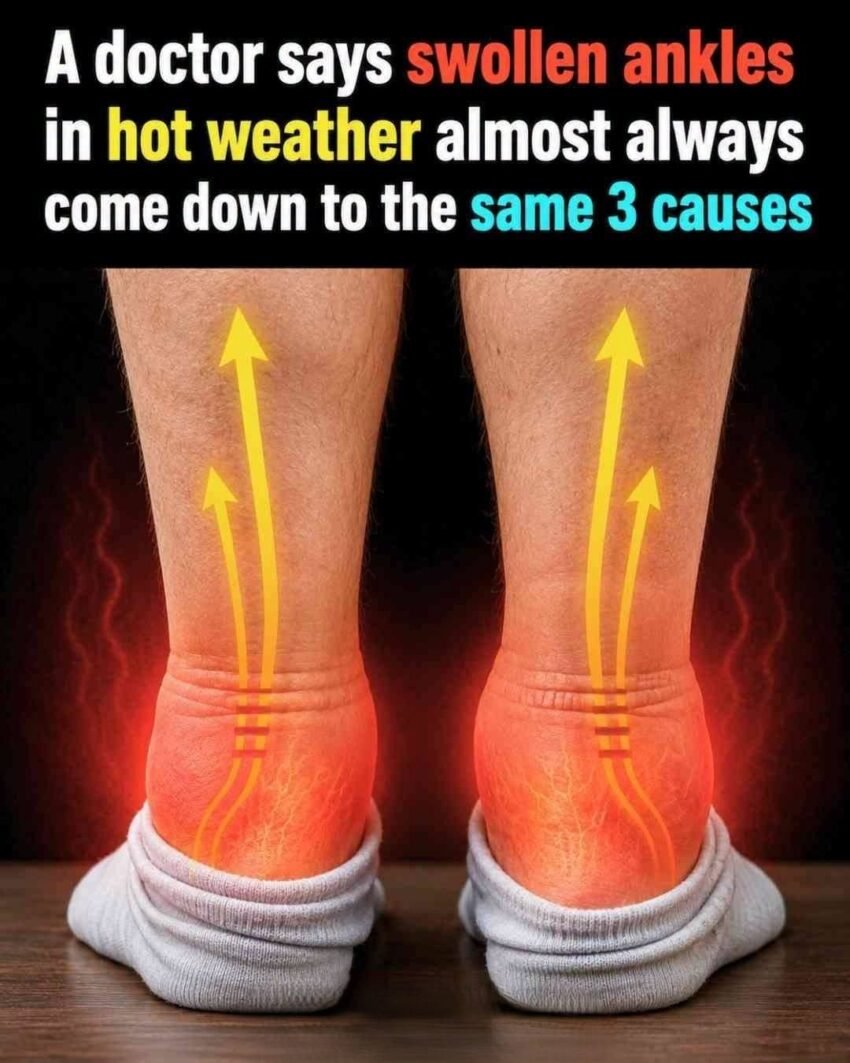
The doctor’s point is likely that it boils down to three fundamental mechanisms, with the heat acting as the trigger. Here’s the breakdown:
1. Vasodilation (The “Tank Overflow” Mechanism)
This is the most common cause. Heat triggers your body to cool itself by widening the blood vessels (vasodilation), especially in the extremities.
-
What Happens: The veins become more “stretchy” and sluggish. Blood pools in the lower legs instead of returning efficiently to the heart.
-
The Fluid Shift: With blood moving slower, the hydrostatic pressure inside the tiniest vessels (capillaries) rises. This pressure forces the watery component of your blood out into the surrounding tissue, like a hose weeping under too much pressure. The result is classic, soft, pitting edema in both ankles.
2. Movement Stagnation (The “Muscle Pump” Failure)
Your calf muscles act as a “second heart.” When you walk, they contract and pump venous blood upward against gravity. Valves inside the veins then snap shut to prevent backflow.
-
What Happens in Heat: People often become far less active in sweltering weather—sitting for long periods or standing still (like in queues or at outdoor concerts).
-
Venous Insufficiency Unmasked: If you have even mild, symptom-free weakness in your vein valves, the combination of gravity, heat-induced dilation, and a non-functional muscle pump will rapidly cause fluid to pool. The heat didn’t cause the valve weakness, but it unmasks it.
3. Capillary Leak from Salt/Volume Overload
Hot weather often changes our habits in subtle ways that affect the delicate balance of fluid filtration.
-
The Diet Connection: Summer diets often include more salty snacks (chips, barbecue, processed picnic foods) and alcoholic drinks. Sodium holds water in the vascular space, and alcohol is a potent vasodilator.
-
Excessive Fluid Intake: If you rapidly drink a massive volume of water to combat heat without adequate electrolyte output, you can transiently expand the blood volume faster than the kidneys can offload it, especially if you’re also not moving.
-
The Mechanism: This isn’t usually heart failure; it’s a pure hydrostatic overload in a system already dilated by heat.
The “Red Flag” Caveat: Is It Just the Heat?
While the doctor is right that these three benign mechanisms are behind most summer ankle swelling, you must know the difference between “heat edema” and a pathological signal. The golden rule is this:
-
Heat Edema: Is always bilateral (both ankles equally) and soft. It pits with your finger, improves significantly overnight or after elevating your legs for an hour, and there is no shortness of breath.
-
When to Act: If the swelling is unilateral (only one leg), warm, red, and painful, this is a DVT (deep vein thrombosis) until proven otherwise. If swelling is bilateral but accompanied by difficulty breathing when lying flat, fatigue, or new breathlessness, it could be the heart struggling with the increased circulatory demand of cooling the body.
In the context of our earlier discussion: if you’re on atorvastatin, a very rare but serious side effect is muscle breakdown (rhabdomyolysis) which can cause fluid shifts and swelling, but this would be accompanied by severe muscle pain and weakness. More commonly, if atorvastatin is preventing a heart attack, it’s protecting you from the true heart failure that causes edema.
Do you notice the swelling going down once you’re in a cool environment and can elevate your legs? That’s the simplest test.