
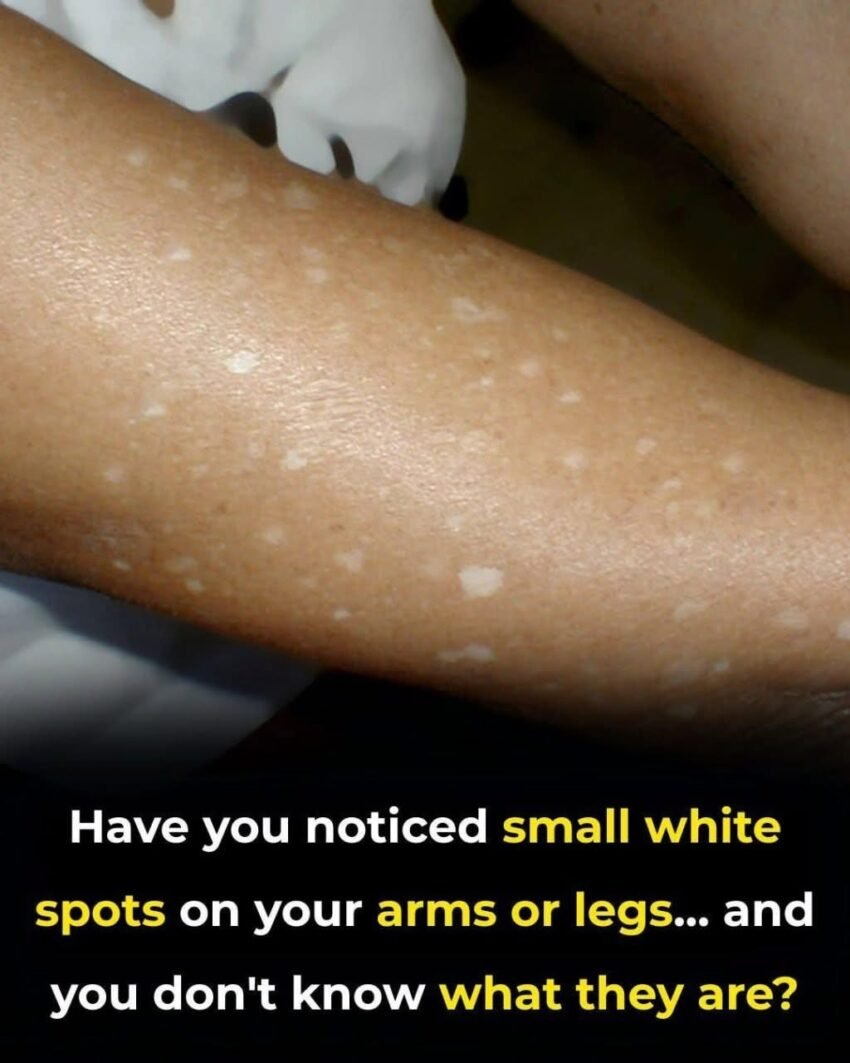
It’s very common to notice these, and they can be alarming if you don’t know what they are. Based on your description, it’s most likely one of two very common, harmless conditions. Here’s a breakdown to help you figure out which one you’re seeing.
The Two Most Likely Culprits
1. Idiopathic Guttate Hypomelanosis (IGH)
This is the most common cause, especially if you’re over 40 and have had significant sun exposure.
-
What it looks like: Small, flat, porcelain-white spots with sharply defined edges. They are usually round and can be 1 to 5 millimeters wide.
-
Where it appears: Most often on the shins and forearms—the areas most exposed to the sun over the years. They can also appear on the face, neck, and shoulders.
-
Who gets it: More common in women and people with fair skin, but anyone can develop it. The likelihood increases with age and cumulative sun exposure.
-
What causes it: A combination of aging and long-term sun damage causes a local decrease in melanocytes (pigment-producing cells). “Idiopathic” simply means the exact cause is unknown, but the link to sun exposure is clear.
-
Key feature: The white spots are smooth, not scaly, and don’t itch. They don’t change in size and are permanent.
2. Tinea Versicolor (Pityriasis Versicolor)
This is more likely if you are younger, live in a warm climate, sweat a lot, or notice the spots change with the seasons.
-
What it looks like: Small, round to oval spots that can be white, pink, tan, or light brown. The key difference is that they may have a very fine, dry scale on the surface that you can see better if you gently scrape the skin.
-
Where it appears: Typically on the upper trunk, upper arms, and neck, but can spread to the forearms and lower legs. The spots are often grouped together and can merge into larger patches.
-
Who gets it: Common in adolescents and young adults. It’s more noticeable in the summer.
-
What causes it: An overgrowth of a yeast (a type of fungus called Malassezia) that naturally lives on everyone’s skin. Factors like heat, humidity, and sweating trigger the overgrowth. The yeast produces a substance that temporarily turns off the melanocytes in that area, causing the skin not to tan. This is why it often becomes visible as “white spots” after sun exposure, while the surrounding skin tans.
-
Key feature: The spots are often slightly scaly and may be mildly itchy, especially when you sweat. This condition is not contagious and is totally harmless.
How to Tell the Difference Quickly
| Feature | Idiopathic Guttate Hypomelanosis | Tinea Versicolor |
|---|---|---|
| Age | Usually over 40 | Teens and young adults |
| Location | Sun-exposed areas (shins, forearms) | Trunk, upper arms, neck |
| Texture | Completely smooth | Fine, dry scale (may be subtle) |
| Season | Constant, doesn’t change | More noticeable in summer |
| Itch | No | Sometimes, when sweating |
Less Common, But Important Rule-Outs
While the two above are harmless, white spots can rarely be a sign of something else. Consult a doctor if you notice:
-
Vitiligo: Patches are completely white and often larger, symmetrical (e.g., both hands, both knees), and lose all pigment. Unlike IGH, the edges may be inflamed or irregular, and it can appear anywhere, including non-sun-exposed areas and the face.
-
Pityriasis Alba: Common in children and adolescents, these are pale, slightly scaly, ill-defined patches on the face. They are often more noticeable after sun exposure and are considered a mild form of eczema.
What You Can Do
-
For suspected IGH: The spots are harmless and don’t require treatment. For cosmetic concerns, a dermatologist can offer treatments like topical retinoids, steroid creams, cryotherapy, or laser therapy to attempt to repigment them, but results vary and they can be stubborn. The most important step is sun protection to prevent new spots from forming.
-
For suspected Tinea Versicolor: This can be treated. Over-the-counter antifungal shampoos, creams, or lotions (containing selenium sulfide, ketoconazole, or zinc pyrithione) applied to the affected areas usually clear it up. Warning: The white spots will remain until your skin re-tans naturally, even after the fungus is gone. Treatment stops the process, but the color takes time to return.
Medical Disclaimer: This information is for educational purposes only. If you have any concerns about a skin condition, new or changing spots, or if a spot has an unusual appearance, it’s essential to see a dermatologist for a proper in-person diagnosis.