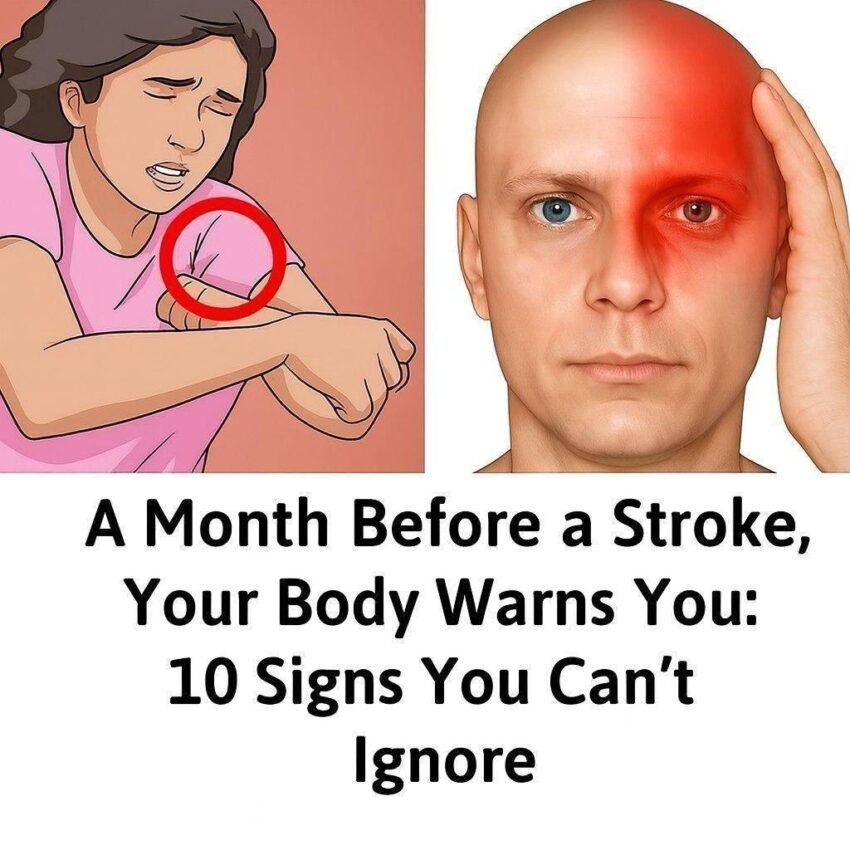
While the title is a bit dramatic (the body doesn’t usually send warnings a full month before a major stroke), it points to a very important truth: warning signs can appear days or even weeks before a serious stroke, often in the form of “mini-strokes” or transient ischemic attacks (TIAs).
Recognizing these early warnings and seeking immediate medical help can be life-saving. It can prevent a major, debilitating stroke from occurring.
Here are 10 signs that your body may be sending an early warning, what they mean, and what you must do about them.
First, a Crucial Distinction: TIA vs. Major Stroke
-
TIA (Transient Ischemic Attack or “Mini-Stroke”): This is a temporary blockage of blood flow to the brain. The symptoms are the same as a stroke, but they typically last only a few minutes to a few hours and then completely resolve. A TIA is a massive warning sign. About 1 in 3 people who have a TIA will eventually have a full-blown stroke, often within a year, and frequently within days or weeks.
-
Major Stroke: This occurs when the blood flow to the brain is blocked long enough to cause permanent brain damage or death.
If you experience any of the signs below, even if they go away, treat it as a medical emergency.
10 Warning Signs Your Body May Send
1. Sudden Numbness or Weakness of the Face, Arm, or Leg
-
What it feels like: This often happens on just one side of the body. You might suddenly feel that your arm is heavy, your leg is dragging, or one side of your face feels numb or droops when you try to smile. It may come and go.
-
Why it happens: A temporary lack of blood flow to the part of the brain that controls movement and sensation.
2. Sudden Confusion, Trouble Speaking, or Understanding Speech
-
What it feels like: You might have sudden difficulty finding the right words, your speech might be slurred, or you might have trouble understanding what someone is saying to you. It can feel like your thoughts are muddled.
-
Why it happens: This affects the language centers of the brain, usually in the left hemisphere.
3. Sudden Trouble Seeing in One or Both Eyes
-
What it feels like: This can be sudden blurred vision, double vision, or even temporary blindness in one eye. Some people describe it as a dark curtain or shade coming down over their vision.
-
Why it happens: Reduced blood flow to the part of the brain or the eye itself (a condition called amaurosis fugax).
4. Sudden Trouble Walking, Dizziness, Loss of Balance, or Coordination
-
What it feels like: You may suddenly feel dizzy, stumble for no apparent reason, or have trouble coordinating your hands to do simple tasks like buttoning a shirt.
-
Why it happens: This often indicates a problem with the blood supply to the brainstem or cerebellum, which control balance and coordination.
5. Sudden, Severe Headache with No Known Cause
-
What it feels like: A completely different kind of headache—often described as the “worst headache of your life.” It comes on suddenly and intensely, like a thunderclap.
-
Why it happens: This is more characteristic of a hemorrhagic stroke (bleeding in the brain), but it can also occur with a major ischemic stroke.
6. Transient Monocular Blindness (Brief Vision Loss)
-
What it feels like: A temporary, painless loss of vision in one eye, often described as a shade being pulled down. It typically lasts only a few seconds or minutes.
-
Why it happens: This is often caused by a temporary blockage of the artery that supplies blood to the retina (the back of the eye) and is a very strong predictor of a future stroke.
7. Extreme, Sudden Fatigue
-
What it feels like: Not just ordinary tiredness, but a sudden, overwhelming, unexplained exhaustion that hits you like a wave and makes it hard to function.
-
Why it happens: While vague on its own, when combined with other symptoms, it can be a sign that the brain is struggling due to reduced blood flow.
8. Brief, Uncontrollable Muscle Twitching or Jerking
-
What it feels like: A sudden, brief episode of involuntary jerking or twitching on one side of the body.
-
Why it happens: This can be a type of seizure caused by a temporary lack of blood flow to a specific area of the brain.
9. A Change in Personality or Mood
-
What it feels like: You or your loved ones might notice a sudden and unexplained change in behavior, such as becoming unusually irritable, agitated, or withdrawn.
-
Why it happens: This can be a sign of reduced blood flow to the frontal lobes, which control personality and behavior.
10. Difficulty Swallowing
-
What it feels like: Suddenly having trouble swallowing food, liquid, or even your own saliva.
-
Why it happens: This can indicate brainstem involvement, which controls automatic functions like swallowing.
What to Do Immediately: B.E. F.A.S.T.
If you or someone with you experiences any of these signs, do not wait. Even if the symptoms go away, you must seek medical attention immediately.
Use the B.E. F.A.S.T. acronym to assess and act:
-
BALANCE: Sudden loss of balance or coordination?
-
EYES: Sudden trouble seeing in one or both eyes?
-
FACE DROOPING: Ask the person to smile. Does one side of the face droop?
-
ARM WEAKNESS: Ask the person to raise both arms. Does one arm drift downward?
-
SPEECH DIFFICULTY: Ask the person to repeat a simple phrase. Is their speech slurred or strange?
-
TIME TO CALL EMERGENCY SERVICES: If you see any of these signs, even if they go away, call for an ambulance immediately. Note the time the first symptom appeared. This is crucial information for the doctors.
The Bottom Line
While the idea of a “one month warning” is an oversimplification, the body does provide critical warnings, often in the form of TIAs. Recognizing these 10 signs and acting F.A.S.T. is the single most important thing you can do to prevent a life-altering stroke. When it comes to stroke, time lost is brain lost.