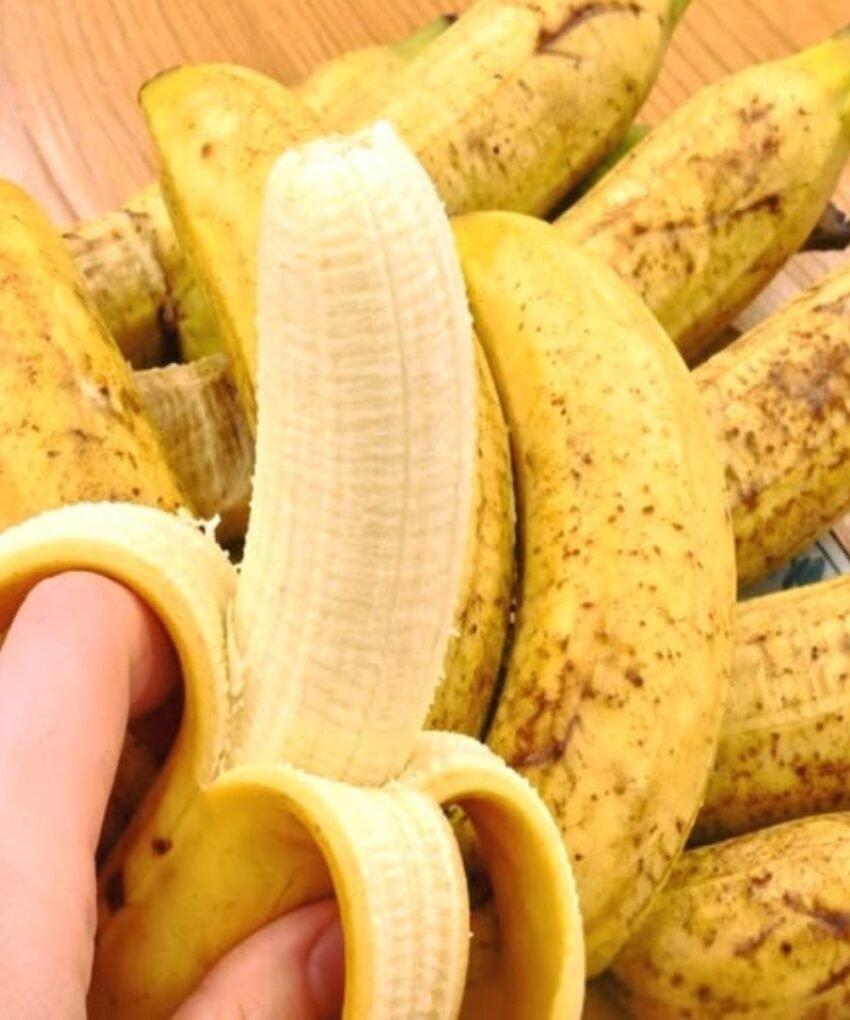
If You’re Over 50, Eating a Banana a Day Causes… (And Why You Should Pay Attention)
For decades, the banana has been marketed as “nature’s perfect snack.” It is portable, cheap, and packed with nutrients. However, if you are over the age of 50, eating a banana every day is not a neutral act—it is a medical intervention that directly affects your blood pressure, kidney function, and blood sugar levels.
Depending on your specific health profile, a daily banana can either be a lifesaving heart tonic or a slow-moving metabolic disaster.
Here is what happens to the body over 50 when you eat a banana every day.
1. A Shift in Potassium Processing (The Kidney Factor)
What happens: Bananas are famous for potassium (about 422 mg per medium fruit). In youth, the kidneys efficiently flush out excess potassium.
The age factor: After 50, kidney function naturally declines (GFR decreases). Kidneys cannot filter potassium as quickly or efficiently.
The risk: If you have undiagnosed or early-stage chronic kidney disease (CKD)—which affects approximately 15% of adults over 50—eating a banana daily can push you toward hyperkalemia (dangerously high blood potassium).
Symptoms: Muscle weakness, numbness, irregular heartbeat, and in severe cases, cardiac arrest.
The nuance: For healthy kidneys, bananas are fine. For compromised kidneys, they are poison.
2. Beta-Blocker Interference (The Heart Medication Problem)
What happens: Bananas are high in potassium. Beta-blockers (commonly prescribed for hypertension and heart disease in patients over 50) cause potassium levels to rise.
The interaction: If you are taking beta-blockers and eating a banana every day, you are double-loading potassium.
The result: You may inadvertently push your serum potassium into the danger zone without realizing it until you experience arrhythmia.
The solution: Patients on beta-blockers should not automatically avoid bananas, but they must keep their intake consistent rather than variable, and monitor blood work closely.
3. Blood Sugar Volatility (The Carb Load)
What happens: A medium banana contains approximately 24–28 grams of carbohydrates, roughly 14 of which are sugar.
The age factor: Insulin sensitivity naturally declines with age. The pancreas works harder to clear glucose from the blood.
The risk: For pre-diabetics or poorly controlled type 2 diabetics, a daily banana acts as a sugar bolus. Unlike berries or apples, bananas have a higher glycemic load, especially when they are spotted or overripe.
The brown spot rule: The riper the banana, the higher the sugar content and the faster it spikes blood glucose.
Who should avoid: Diabetics with HbA1c above target should treat a banana as a dessert, not a free snack.
4. Medication Interference (ACE Inhibitors and Potassium-Sparing Diuretics)
What happens: Many patients over 50 are prescribed ACE inhibitors (Lisinopril, Enalapril) or potassium-sparing diuretics (Spironolactone) for high blood pressure or heart failure.
The mechanism: These drugs explicitly prevent the body from excreting potassium.
The consequence: Eating a banana daily while on these medications is like stepping on the gas and the brake simultaneously. Your potassium drifts upward silently until it reaches a threshold that affects cardiac conduction.
The bottom line: If you are on these medications, your doctor has likely already warned you to avoid high-potassium foods in excess. Bananas qualify.
5. Gastrointestinal Slowdown (The Constipation Myth)
What happens: Bananas are often recommended for constipation. This is misleading.
The age factor: The aging colon moves more slowly. Peristalsis weakens.
The reality: Unripe bananas are high in resistant starch, which can be difficult to break down and can actually worsen constipation and bloating in seniors with already slow motility.
Ripe vs. Unripe: Very ripe bananas (brown spots) are easier to digest. Green bananas can cause gas, bloating, and impaction in susceptible individuals.
6. Migraine Trigger (The Tyramine Connection)
What happens: Bananas contain tyramine, an amino acid that triggers blood vessel dilation.
The age factor: Many adults over 50 develop late-onset migraines or chronic tension headaches.
The link: For migraine-prone individuals, the tyramine in overripe bananas can trigger an attack within hours.
The pattern: If you notice headaches after eating very spotted bananas, switch to greener bananas or eliminate them entirely.
7. Weight Management and Satiety
What happens: A banana is approximately 100–120 calories.
The trade-off: For sedentary adults over 50, metabolic rate has dropped. That 120-calorie banana displaces the opportunity for lower-sugar, higher-fiber fruits like berries.
The argument: If you are trying to lose weight or maintain weight, a banana provides less volume and satiety per calorie compared to an equivalent serving of strawberries or an apple.
The verdict: It is not “fattening,” but it is not optimal for weight loss in the aging metabolic landscape.
Summary: Should You Eat a Banana Every Day After 50?
Yes, if:
-
Your kidneys are healthy (confirmed by recent blood work).
-
You are not on beta-blockers, ACE inhibitors, or potassium-sparing diuretics.
-
You are not diabetic or pre-diabetic.
-
You eat them in the green-to-mid-ripe stage.
No, if:
-
You have chronic kidney disease (even stage 2 or 3).
-
You take blood pressure medication that retains potassium.
-
You struggle with blood sugar control.
-
You have slow gut motility and eat unripe bananas.
The Final Takeaway
For a healthy 50-year-old, a banana a day is generally safe. However, “healthy” is a moving target in this demographic. The difference between a banana being a superfood and a danger is determined entirely by your medication list and your kidney function.