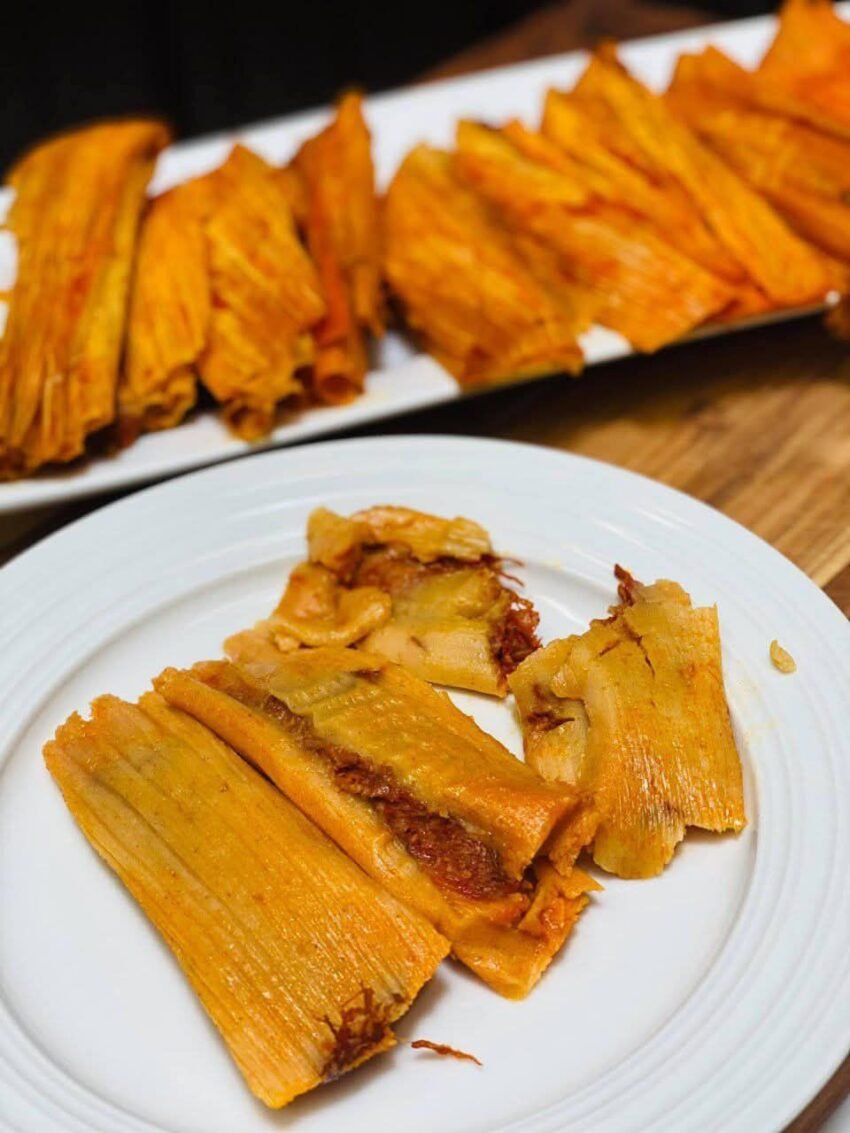
Making Authentic Mexican Chile Colorado Tamales is a labor of love, but the result is incredibly rewarding. “Chile Colorado” translates to “colored red,” referring to the rich, deep red broth made from dried chiles that the pork is braised in.
This recipe is broken down into three main components: the filling (pork in red sauce), the masa (corn dough), and assembly.
Tips for Success
-
Broth is key: Don’t throw out the pork braising liquid! You’ll use it to flavor the masa and the sauce.
-
Toast the chiles: Lightly toasting the dried chiles brings out their deep, smoky flavor.
-
Masa consistency: The single most important step for fluffy tamales is getting the masa the right texture. It should be about the consistency of peanut butter or hummus—spreadable but not runny. The “float test” (dropping a tiny piece of masa into cold water; if it floats, it’s ready) is a great way to check.
Ingredients
For the Pork & Red Chile Sauce
-
3 lbs pork shoulder (or pork butt), cut into 2-inch cubes
-
6-8 dried Guajillo chiles, stems and seeds removed
-
2 dried Ancho chiles, stems and seeds removed
-
1 medium onion, quartered
-
4 cloves garlic
-
1 teaspoon ground cumin
-
1 teaspoon dried Mexican oregano
-
2 bay leaves
-
Salt and pepper to taste
-
4-6 cups water or low-sodium chicken broth
For the Masa (Dough)
-
2 lbs (about 4 cups) Masa Harina (corn flour for tamales; Maseca is a common brand)
-
1 cup reserved pork braising liquid (cooled)
-
1-1.5 cups reserved red chile sauce (cooled)
-
1 tablespoon baking powder
-
1 teaspoon salt
-
1 cup lard or vegetable shortening (must be at room temperature)
-
1-1.5 cups warm chicken broth or water (to adjust consistency)
For Assembly
-
1 package dried corn husks (about 30-40 husks)
-
Optional: Hot water for soaking husks
Instructions
Day Of: Prepare the Husks
-
Soak the husks: Place the corn husks in a large bowl or sink filled with hot water. Place a heavy plate on top to keep them submerged. Soak for at least 2-3 hours, or overnight. They should be soft and pliable.
Step 1: Make the Chile Sauce and Braise the Pork
-
Toast the chiles: Heat a dry comal or skillet over medium heat. Open the dried chiles flat and toast them for a few seconds per side until they become fragrant. Do not burn them or they will become bitter.
-
Rehydrate: Place the toasted chiles in a bowl and cover with hot water. Let them soak for 20-30 minutes until softened.
-
Blend: Drain the soaked chiles and place them in a blender with the onion, garlic, cumin, oregano, and about 1 cup of fresh water or broth. Blend until completely smooth.
-
Strain: For a silky sauce, pour the blended mixture through a fine-mesh strainer into a bowl to remove any bits of skin.
-
Brown the pork: Season the pork cubes generously with salt and pepper. In a large heavy-bottomed pot or Dutch oven, heat a little oil over medium-high heat and brown the pork on all sides. Work in batches to avoid crowding the pan.
-
Braise: Return all the pork to the pot. Pour the strained chile sauce over the meat and add the bay leaves. Add enough water or broth to just barely cover the meat.
-
Cook: Bring to a boil, then reduce heat to low, cover, and simmer for 2 to 2.5 hours, or until the pork is fall-apart tender.
-
Shred: Remove the pork from the pot. Once cool enough to handle, shred the meat with two forks. Reserve the cooking liquid separately from the shredded meat. You will use this red broth for the masa.
Step 2: Make the Masa (Dough)
-
Cream the fat: In a large stand mixer with the paddle attachment (or with a hand mixer), beat the room-temperature lard or shortening with the baking powder and salt until it is light and fluffy (about 2-3 minutes).
-
Incorporate the liquids: In a separate bowl, whisk together the cooled reserved red chile sauce and the cooled pork broth.
-
Mix: With the mixer on low speed, gradually add the Masa Harina to the fluffed lard, alternating with the red sauce/broth mixture. Mix until a dough forms.
-
Adjust consistency: The dough will be thick. Slowly add warm chicken broth or water, a few tablespoons at a time, until the masa reaches a spreadable, hummus-like consistency.
-
The Float Test: Drop a tiny ball (1/2 teaspoon) of masa into a cup of cold water. If it floats, the fat is properly incorporated and it’s ready. If it sinks, continue beating for another 2-3 minutes and test again.
Step 3: Assemble the Tamales
-
Prepare the husks: Remove a husk from the water and pat it dry. Tear a few thin strips from one husk to use as ties (optional).
-
Spread the masa: Lay a husk flat with the wide end at the top. Using the back of a spoon or an offset spatula, spread about 2-3 tablespoons of masa (depending on husk size) onto the upper half of the husk, leaving at least a 2-inch border at the bottom and a 1-inch border on the sides.
-
Add filling: Place about 1-2 tablespoons of the shredded pork in a line down the center of the masa.
-
Fold: Fold one side of the husk over the filling so the masa meets. Fold over the other side, wrapping the filling completely inside the masa. Fold the empty bottom flap of the husk up.
-
Stand: Place the tamale upright (with the folded flap on the bottom to prevent unrolling) in a tamale steamer pot or on a rack inside a large pot. Pack them in tightly so they don’t fall over during cooking.
Step 4: Steam the Tamales
-
Add water to the pot below the steamer rack, making sure the water does not touch the tamales.
-
Place a few extra corn husks or a damp kitchen towel over the top of the tamales to help trap steam and prevent condensation from dripping on them.
-
Cover the pot with a tight-fitting lid.
-
Bring water to a boil, then reduce heat to medium-low. Steam for 60 to 90 minutes.
-
Check for doneness: Carefully remove one tamale and open it. If the husk peels away cleanly from the masa without sticking, they are done. If it sticks, they need more time.
-
Let the tamales rest for 10-15 minutes before serving to allow the masa to set.
Enjoy your tamales with salsa, beans, or rice!