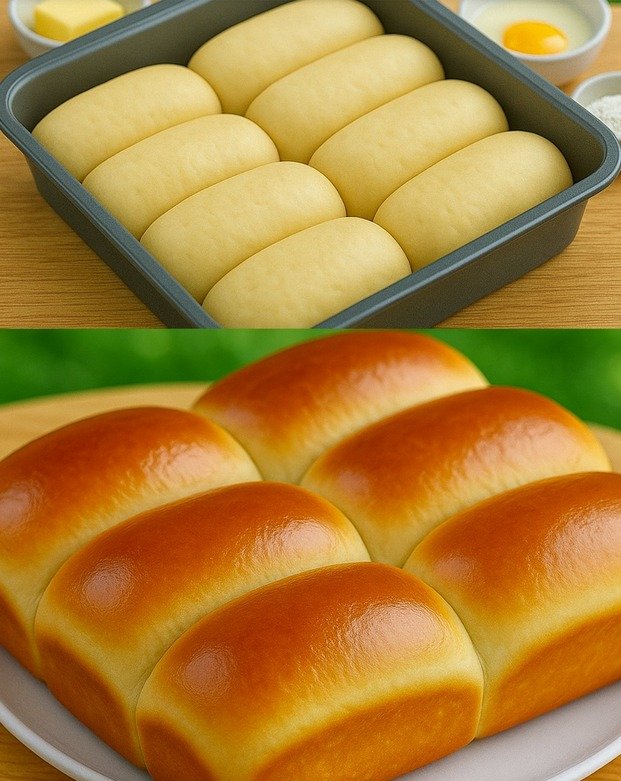
These are not dinner rolls. These are clouds rendered edible—a crumb so feathery it barely registers as substance, a crust so thin and golden it surrenders instantly to the tooth.
Japanese milk buns (Hokkaido milk bread) achieve their signature softness through a simple but transformative technique: tangzhong. This is not a secret; it is science. A paste of flour and milk, cooked briefly, gelatinizes the starches and allows them to retain vastly more moisture than a conventional dough.
The result is a bun that stays soft for days, needs no butter to be delicious, and makes every other dinner roll you have ever eaten feel like a dry, dusty apology.
Ultra Soft Japanese Milk Buns
Tangzhong Method • Feathery Crumb • Golden Cap
Yield: 8–9 buns (8-inch round or square pan)
Oven: 350°F (175°C)
Ingredients
For the Tangzhong (The Secret):
-
3 tablespoons (20g) bread flour
-
½ cup (120ml) whole milk
-
¼ cup (60ml) water
For the Dough:
-
2 ½ cups (320g) bread flour (plus more for dusting)
-
¼ cup (50g) granulated sugar
-
2 teaspoons (7g) instant yeast
-
1 teaspoon salt
-
½ cup (120ml) whole milk, lukewarm
-
1 large egg, room temperature
-
3 tablespoons (42g) unsalted butter, softened
For the Egg Wash:
-
1 large egg
-
1 tablespoon milk
Method
1. The Tangzhong
In a small saucepan, combine the tangzhong flour, milk, and water. Whisk until no lumps remain.
Place over medium-low heat. Stir continuously, scraping the bottom and edges. Within 2–3 minutes, the mixture will thicken dramatically—from thin liquid to paste to something resembling mashed potatoes.
Stop when the whisk leaves distinct tracks that do not immediately flow back together.
Transfer the tangzhong to a small bowl. Cover with plastic wrap pressed directly against the surface (this prevents a skin from forming). Cool to room temperature.
Do not skip this. The tangzhong is not optional; it is the architecture of softness.
2. The Dough
In the bowl of a stand mixer fitted with the dough hook, combine the bread flour, sugar, instant yeast, and salt. Whisk briefly with your hand to distribute.
In a separate measuring cup, whisk together the lukewarm milk, egg, and the cooled tangzhong. The tangzhong will not dissolve completely; it will break into small curds. This is correct.
With the mixer running on low, pour the wet ingredients into the dry. Mix until a shaggy mass forms, about 1–2 minutes. Scrape the bowl.
Rest, covered, for 20 minutes. This autolyse (even without the full technique) allows the flour to absorb the liquid and begins gluten development passively. You are doing the work without the work.
3. The Butter
After the rest, resume mixing on medium-low. Add the softened butter, one tablespoon at a time, waiting until each addition is mostly incorporated before adding the next.
The dough will look angry. It will separate, slide greasily, and seem irreparably broken. This is normal. Keep mixing.
After 8–10 minutes, the dough will coalesce into a smooth, supple, very soft ball. It should pass the windowpane test: pinch off a small piece and stretch it gently between your fingers. If it forms a thin, translucent membrane without tearing, the gluten is developed.
If using a mixer: 10–12 minutes total.
If kneading by hand: 15–18 minutes. Slap, fold, rest. Be patient.
4. The First Rise
Shape the dough into a smooth ball. Place it in a lightly oiled bowl, turning to coat. Cover tightly with plastic wrap.
Let rise in a warm place until doubled, about 1–1.5 hours. The time depends on your ambient temperature; look for the volume, not the clock.
5. The Shape
Gently deflate the dough. Turn it out onto a lightly floured surface.
Divide the dough into 8 or 9 equal pieces (about 75–80g each). A bench scraper and kitchen scale are your friends here.
To shape each bun:
-
Flatten a piece into a rough circle.
-
Fold the edges inward toward the center, like a parcel.
-
Pinch the seams together firmly.
-
Flip the bun seam-side down. Cup your hand over it and drag it in small circles on an unfloured surface. The tension will pull the surface taut.
Arrange the buns in a buttered 8-inch round or square pan (or line with parchment). They should be close but not touching; they will grow into each other during the second rise.
6. The Second Rise
Cover the pan loosely with plastic wrap or a damp tea towel.
Let rise until the buns are puffy, doubled, and nestled snugly against one another, about 45–60 minutes.
Near the end of the rise, preheat your oven to 350°F (175°C) .
7. The Bake
Whisk the egg and milk together for the egg wash. Brush gently over the tops of the buns. Do not let it pool at the base.
Bake for 20–25 minutes, until the tops are deep golden brown and the internal temperature registers 190°F (88°C) .
If the tops are browning too quickly, tent loosely with foil at the 15-minute mark.
8. The Finish
Remove from the oven. Immediately brush the tops with softened butter—this creates a soft, luscious crust rather than a crisp one.
Let the buns cool in the pan for 5 minutes, then transfer to a wire rack.
Resist the urge to tear into them immediately. They are still setting. Wait 10 minutes. Then pull one apart and watch the steam rise.
Three Critical Notes
1. On Flour:
Bread flour is non-negotiable here. Its higher protein content (12–13%) creates the gluten network necessary to support the high hydration of this dough. All-purpose flour will yield a denser, less ethereal crumb.
2. On Hydration:
This is a very soft, sticky dough. Do not be tempted to add excessive flour during shaping. Lightly flour your hands and work surface, but trust the process. A slightly tacky dough yields a tender bun; a floured-dry dough yields a brick.
3. On Storage:
These buns are at their peak the day they are baked, but the tangzhong keeps them remarkably soft for days. Store in an airtight container at room temperature for 2–3 days. Refresh briefly in a 300°F oven for 5 minutes.
To freeze: Wrap tightly in foil and place in a freezer bag. Thaw at room temperature and reheat gently.
The Philosophy of Softness
These buns are not about complexity. They do not contain seeds, grains, herbs, or fillings. They are not trying to impress you with novelty.
They are trying to impress you with execution.
A perfect Japanese milk bun is a meditation on restraint: the correct flour, the correct hydration, the correct temperature, the correct patience. It asks you to trust that a lump of sticky dough, handled properly, will transform into something transcendent.
And it will.
Pull one apart. The strands will web and stretch. The crumb will shimmer. And you will understand why, in Japan, bread is not a convenience food—it is a craft.