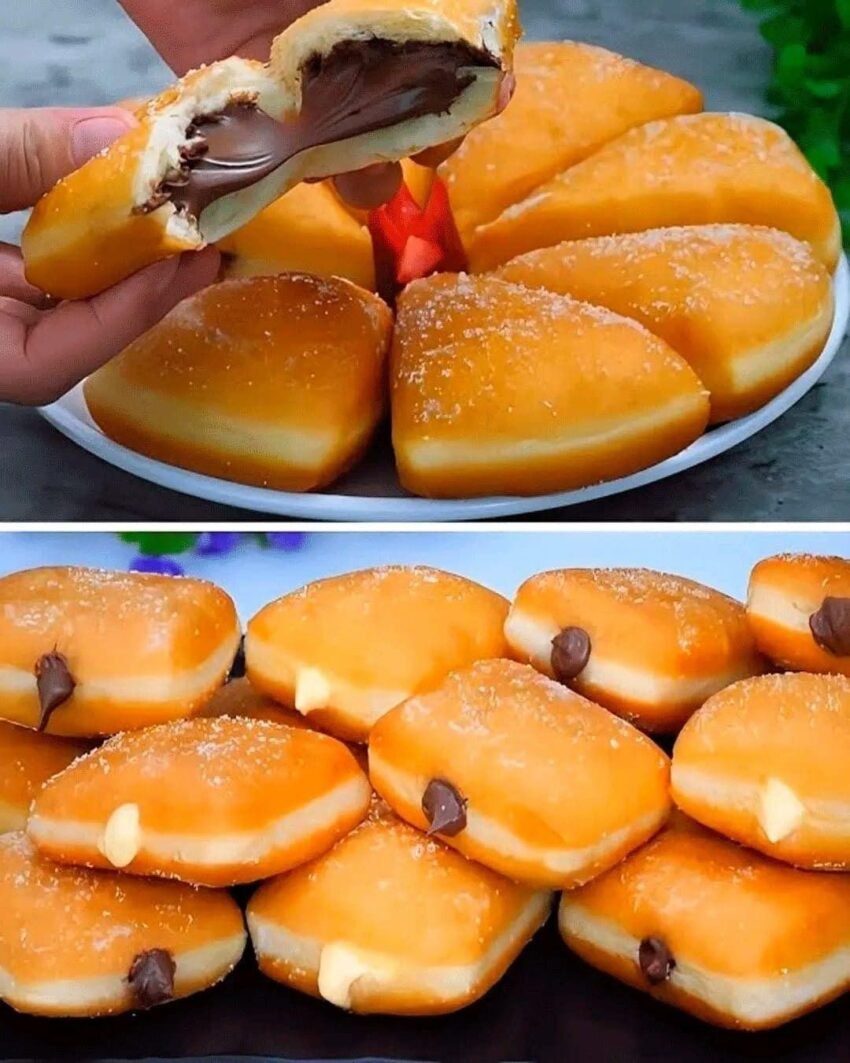
This is a universal favorite! Stuffed donuts are irresistibly delicious—a soft, fluffy exterior giving way to a burst of creamy, fruity, or decadent filling. Making them at home is a special treat, and the result is far superior to anything store-bought.
Here is a comprehensive guide and recipe for Stuffed Donuts (specifically, a classic yeast-raised donut filled with pastry cream or jam).
Homemade Stuffed Donuts
This recipe yields incredibly light, airy donuts. You can fill them with whatever you like—classic vanilla pastry cream, rich chocolate custard, raspberry jam, or lemon curd.
Yields: 12-14 donuts
Prep time: 30 minutes (plus 1.5-2 hours rising time)
Cook time: 2-3 minutes per batch (for frying)
For the Donut Dough
-
1 cup whole milk, warmed to about 110°F (43°C)
-
¼ cup granulated sugar
-
2 ¼ teaspoons (1 packet) active dry yeast
-
2 large eggs, at room temperature
-
¼ cup unsalted butter, melted
-
1 teaspoon vanilla extract
-
½ teaspoon salt
-
4 cups all-purpose flour (plus more for dusting)
-
Vegetable or canola oil, for frying
For the Vanilla Pastry Cream Filling
-
2 cups whole milk
-
½ cup granulated sugar
-
4 large egg yolks
-
¼ cup cornstarch
-
¼ teaspoon salt
-
2 teaspoons vanilla extract
-
2 tablespoons unsalted butter
For Finishing
-
1 cup granulated sugar (for coating)
-
1 teaspoon cinnamon (optional, for cinnamon sugar)
-
Your choice of filling: Pastry cream (recipe below), raspberry or strawberry jam, lemon curd, chocolate hazelnut spread, etc.
Instructions
Step 1: Make the Pastry Cream (Can be done a day ahead)
-
In a medium saucepan, heat the milk over medium heat until it’s hot but not boiling (small bubbles around the edge).
-
In a separate bowl, whisk together the sugar, egg yolks, cornstarch, and salt until pale and thick.
-
Temper the eggs: Slowly pour about ½ cup of the hot milk into the egg mixture while whisking constantly. This prevents the eggs from scrambling.
-
Pour the tempered egg mixture back into the saucepan with the remaining milk. Cook over medium heat, whisking constantly, until the mixture thickens and comes to a gentle boil. It should be thick enough to hold its shape.
-
Remove from heat and whisk in the vanilla extract and butter until smooth.
-
Pour the pastry cream through a fine-mesh sieve into a bowl to remove any lumps. Cover with plastic wrap, pressing it directly onto the surface of the cream to prevent a skin from forming. Refrigerate until completely cold and set (at least 2 hours, or overnight).
Step 2: Make the Donut Dough
-
Proof the yeast: In the bowl of a stand mixer, combine the warm milk, 1 tablespoon of the sugar, and the yeast. Let it sit for 5-10 minutes until it becomes foamy.
-
Form the dough: Add the remaining sugar, eggs, melted butter, vanilla, salt, and 2 cups of the flour. Mix with the paddle attachment until combined.
-
Switch to the dough hook. With the mixer on low, gradually add the remaining flour, ½ cup at a time, until the dough comes together and pulls away from the sides of the bowl. It should be soft and slightly sticky.
-
Knead with the dough hook on medium-low speed for 5-7 minutes until the dough is smooth and elastic.
-
First Rise: Place the dough in a lightly oiled bowl, turning to coat. Cover with plastic wrap or a clean kitchen towel and let it rise in a warm place until doubled in size, about 1-1.5 hours.
Step 3: Shape the Donuts
-
Punch down the risen dough to release the air. Turn it out onto a lightly floured surface.
-
Roll the dough out to about ½-inch thickness.
-
Use a 3-inch round cutter (or a drinking glass) to cut out as many circles as possible. Place the circles on a parchment-lined baking sheet, leaving some space between them.
-
Gather the scraps, gently re-roll, and cut out more circles.
-
Second Rise: Cover the cut donuts loosely with a clean towel and let them rise again until puffy and almost doubled, about 30-45 minutes.
Step 4: Fry the Donuts
-
In a large, heavy-bottomed pot (like a Dutch oven), heat about 2-3 inches of oil to 350°F (175°C). Use a thermometer to maintain the temperature.
-
Carefully place 2-3 donuts at a time into the hot oil (don’t overcrowd). Fry for about 1 minute per side, until golden brown.
-
Use a slotted spoon to remove the donuts and transfer them to a wire rack set over a paper towel-lined baking sheet to drain.
-
Coat: While the donuts are still warm, toss them in a bowl of granulated sugar (or cinnamon sugar) until evenly coated.
Step 5: Fill the Donuts
-
Prepare your fillings. Transfer the chilled pastry cream, jam, or other filling to a piping bag fitted with a long, thin tip (like a Bismarck or round tip).
-
Insert the tip into the side of a donut and gently squeeze to fill. You’ll feel the donut plump up slightly. Don’t overfill, or it will burst out the other side!
-
Repeat with all the donuts.
Step 6: Serve and Enjoy
These are best enjoyed the day they are made. Serve them immediately and watch them disappear!
Tips for Success
-
Temperature is Key: Ensure your milk is warm (not hot) to properly proof the yeast. Keep your frying oil at a consistent 350°F—too hot and the outside burns before the inside cooks; too cool and the donuts absorb excess oil and become greasy.
-
Don’t Overcrowd the Pot: Frying too many donuts at once will lower the oil temperature drastically.
-
Get the Right Tip: A long, narrow filling tip is essential for getting the filling into the center of the donut without making a huge hole.
-
Variations:
-
Chocolate Filling: Add 4 oz of melted dark chocolate to the pastry cream after straining.
-
Lemon Filling: Use lemon curd for a tangy burst.
-
Boston Cream: Fill with vanilla pastry cream and top with a rich chocolate glaze.
-