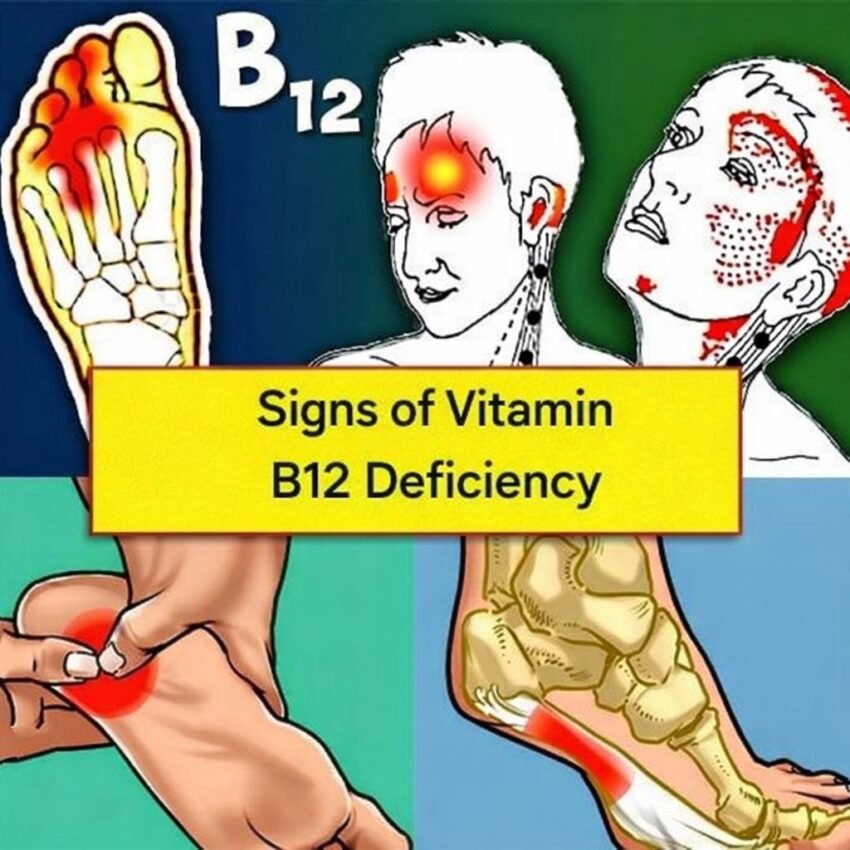
Here’s why it becomes so critical after 40 and the specific warning signs to watch for.
Why B12 Becomes Critical for Women Over 40
Unlike other vitamins, B12 absorption is a complex process that declines sharply with age. You can eat plenty of B12, but your body may not be able to extract it. The three main reasons are:
-
Declining Stomach Acid: After 40, many women produce less stomach acid. You need strong acid to separate B12 from the protein in your food. Without it, B12 passes through undigested.
-
Medication Interference: Two classes of drugs commonly prescribed to women over 40 are notorious for causing B12 deficiency:
-
Metformin: The first-line drug for PCOS and type 2 diabetes.
-
Proton Pump Inhibitors (PPIs): Stomach acid blockers like omeprazole (Prilosec) for heartburn/reflux.
-
-
Autoimmune Attack (Pernicious Anemia): As we age, the risk increases for an autoimmune condition where the body attacks the “Intrinsic Factor,” a protein needed to absorb B12 in the gut.
You cannot fix this with diet alone if the absorption mechanism is broken.
The Warning Signs of Deficiency
The symptoms are often misdiagnosed as depression, menopause, stress, or early-onset dementia. Here’s what to look for, divided by how they affect the body:
Brain & Mood (Often Mistaken for Menopause)
-
Brain Fog & Memory Loss: Forgetting names, why you walked into a room, or struggling with concentration. This can be terrifying but is a classic B12 symptom.
-
Depression & Anxiety: B12 is required to synthesize mood-regulating neurotransmitters like serotonin and dopamine. A deficiency can cause treatment-resistant depression.
-
Irritability: Feeling uncharacteristically short-tempered or overwhelmed.
Nerve & Sensation (The “Pins and Needles” Sign)
-
Peripheral Neuropathy: Numbness, tingling, or a “pins and needles” sensation in the hands and feet. This is a hallmark sign that the myelin sheath protecting your nerves is being damaged.
-
Balance Issues & Dizziness: Feeling unsteady on your feet, as if you’re walking on a boat, or a sudden onset of vertigo.
-
Burning or Electric Shock Sensations: Some women describe a “zapping” pain or a sensation of wearing tight gloves or socks when they aren’t.
Energy & Body (Often Mistaken for “Slowing Down”)
-
Profound Fatigue: This isn’t just being tired after a long day. It’s a deep, crushing, “can’t-get-out-of-bed” exhaustion because your body can’t produce enough oxygen-carrying red blood cells.
-
Breathlessness: Feeling winded after minor exertion, like climbing a single flight of stairs.
-
Tinnitus: Unexplained ringing in the ears.
Physical Appearance & Senses
-
Pale or Jaundiced Skin: The lack of red blood cells causes pallor, and the rapid breakdown of fragile, malformed blood cells can release bilirubin, giving the skin a faint yellow tinge.
-
Glossitis (Swollen Tongue): A smooth, swollen, red, and sometimes painful tongue. You might lose the little bumps (papillae) on your tongue.
-
Thinning Hair: Increased shedding or lackluster hair due to impaired cell reproduction.
-
Blurred Vision: Damage to the optic nerve can cause visual disturbances.
The Critical Lab Test Many Doctors Miss
If you have these symptoms, you must ask for specific blood work. A standard “serum B12” test can be misleading because it measures total B12 in the blood, not how much is actually getting into your cells.
-
The Basics: Request a Serum B12 test. Note: In Japan and Europe, levels below 500 pg/mL are treated, but many U.S. labs flag only levels below 200 pg/mL as low. You can be severely symptomatic in the 200-400 range.
-
The Gold Standard: Ask for Holotranscobalamin (Active B12) . This measures only the B12 that is bioavailable to your cells.
-
The Confirmers: Ask for Methylmalonic Acid (MMA) and Homocysteine. If these are high, you have a functional B12 deficiency at the cellular level, regardless of your serum level.
If You Are Deficient: Oral vs. Injections
-
For Dietary Deficiency (Eating enough, but levels are borderline): High-dose sublingual or chewable methylcobalamin (the active form) is often effective.
-
For Absorption Issues (Low acid, autoimmune, Metformin use): Oral supplements likely won’t work because the absorption mechanism is broken. You bypass the gut entirely with B12 injections (usually hydroxocobalamin) or high-dose sublingual liquids that absorb through the mouth’s lining. In the UK and Canada, B12 injections are standard first-line treatment for neurological symptoms.
Always consult your doctor. If a B12 deficiency has been long-standing, correcting it too quickly can cause a dangerous electrolyte imbalance (hypokalemia), so high-dose therapy should be medically supervised.