
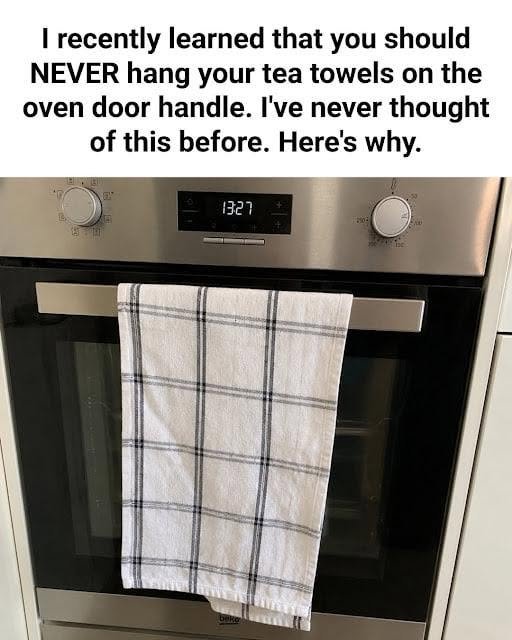
It’s a habit born of convenience—drying your hands, grabbing a hot lid, wiping a spill—but that innocent-looking towel draped over the oven door handle is a genuine recipe for disaster. Let’s break down exactly why, and then I’ll give you a smarter, safer kitchen workflow.
The Hidden Dangers of the Oven Door Towel
This single habit compounds multiple risks into one dangerous focal point.
1. The Fire Hazard: Your Oven’s Exhaust Is a Thermal Threat
Your oven door isn’t a sealed, perfectly insulated unit. During and after use, hot air vents from the door, especially around the edges and the handle. A tea towel, usually made of cotton or linen, has a combustion point between 400-500°F (204-260°C). When you’re broiling, the top of the door can easily reach temperatures that will char and eventually ignite that towel. This often happens when someone turns on the broiler, forgets the towel is there, and leaves the room. The fire starts silently, fueled by a dry, grease-splattered cloth.
2. The Cross-Contamination Station
Think of the journey of that towel during a single meal prep:
-
You handle raw chicken, rinse your hands briefly, and wipe them on the towel. Salmonella and Campylobacter are now resident.
-
You later use that same towel to dry a clean salad bowl or wipe a child’s face.
-
You drape it back on the handle. A toddler grabs it to pull themselves up, transferring bacteria directly to their hands.
That towel is now the single most contaminated object in your kitchen, acting as a pathogen transfer station between every surface, your hands, and your food.
3. The Physical Burn and Tip Hazard
-
A False Grab Point: The towel hanging from the oven handle creates an inviting, soft loop. It’s instinctual to grab it. If the oven door is hot, your knuckles press directly against the scorching metal.
-
The Toddler Pull: A small child sees a dangling, colorful towel. They grab it and pull. An unlocked oven door can swing open, and a pot of boiling water on the stovetop above is now within reach. This has led to catastrophic scald burns in children.
-
The Sleeve Snag: Walking past with a pot of hot liquid, a sleeve or pocket can snag the towel, pulling the hanging cloth and the pot off-balance.
The Safer, Smarter Kitchen Flow
The goal is to replace one multi-purpose, dangerously placed towel with a system of dedicated, location-specific tools. Professional kitchens use a color-coded towel system for exactly this reason.
The Three-Towel System (Color-Coded)
-
The Hand Towel (Designated & Draped on You, Not the Oven):
-
Where: Hooked to your apron, tucked into your waistband, or draped over your shoulder. This is for drying clean hands only.
-
Alternative Location: A command hook placed on a lower cabinet door, well away from the heat zone and walking path. Never on the oven.
-
-
The “Dirty” Tool Towel (For Spills & Surfaces):
-
Where: Hung on the sink edge or a dedicated hook at the prep station.
-
Rule: This towel touches counters, cutting boards, and spills. It never touches clean hands or clean dishes. It goes straight into the laundry after a meal prep involving raw meat.
-
-
The Heat Handler (Dry & Tucked Away):
-
Where: A drawer, a countertop holder, or a hook immediately next to the stove but never in contact with it.
-
Rule: This is a heavy-duty, 100% dry, thick cotton or silicone oven mitt/pad. A damp or greasy towel conducts heat instantly and causes steam burns. This tool is for hot pans only. Never use a hand towel to grab a hot pan; the steam burn from residual moisture is instantaneous and severe.
-
The Workflow Change
When you empty the dishwasher, don’t hang the clean tea towel on the oven door. Instead, fold it and place it on the counter, or hang it on the designated “clean hands” hook. When you cook, wear an apron with a towel loop. If a towel falls on the floor, it goes in the laundry basket immediately—no exceptions.
This isn’t about being overly fastidious; it’s about designing the physical environment of your kitchen so that safety is the path of least resistance. The oven door handle must become a no-go zone for fabric, permanently. Your future self, and anyone small enough to grab that dangling cloth, will be safer for it.