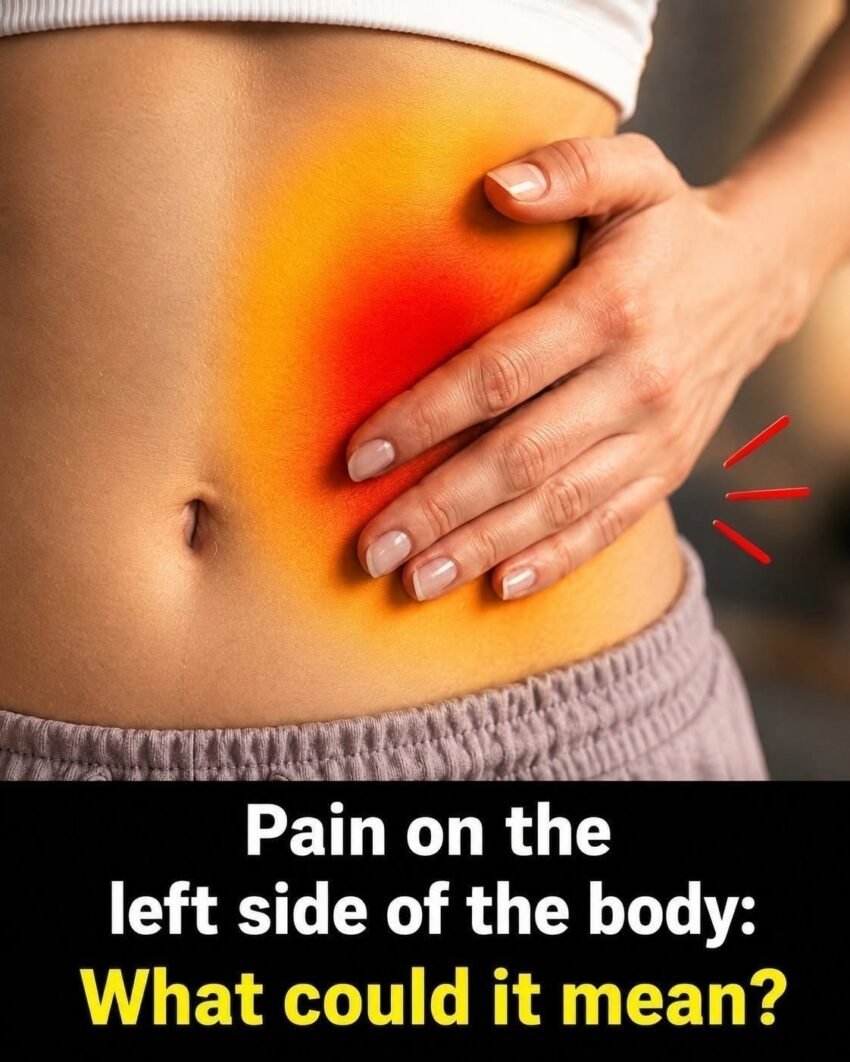
Pain localized to the left side of the body presents a specific diagnostic challenge because it can originate from structures as diverse as the heart, the spleen, the kidney, or the gastrointestinal tract. The left side is uniquely home to some organs that simply don’t exist on the right, making the location a critical clue.
The most important first step is to immediately rule out the life-threatening cardiac cause. After that, you can systematically narrow it down by the specific zone of pain.
🚨 The First Question: Is It Your Heart?
Because the heart is situated on the left side of the chest, any left-sided discomfort above the waist must first be assumed to be cardiac until proven otherwise. Do not gamble with this.
Call for emergency medical help immediately if your left-sided pain is accompanied by any of these:
-
A squeezing, pressure, tightness, or crushing sensation in the center or left chest. It may radiate to the left shoulder, left arm (especially the inside of the arm), jaw, or between the shoulder blades.
-
Cold sweats, nausea, or lightheadedness that comes on suddenly with the pain.
-
Shortness of breath that is new and disproportionate to your activity.
-
A sense of impending doom—a profound, instinctual feeling that something is catastrophically wrong.
Critical Note for Women and Diabetics: You may not experience the classic “crushing chest pain.” Your only symptoms might be profound fatigue, nausea, jaw pain, or shortness of breath. If your body is telling you something is deeply wrong, trust that instinct.
If the pain is sharp, stabbing, fleeting, and you can reproduce it by pressing on the spot or moving a certain way, it is less likely to be cardiac, but this determination needs a medical professional, not a self-diagnosis.
The Zone Diagnosis: What’s Under Your Left Rib?
Once cardiac pain has been ruled out, you can map the location of the pain to specific organs.
Upper Left Abdomen (Under the Ribs, Radiating to the Shoulder)
Think: Spleen.
-
What It Is: The spleen sits directly under the left ribcage and is protected by ribs 9, 10, and 11. Pain here is often a dull ache or a feeling of fullness and pressure.
-
The Emergency: A ruptured spleen is a life-threatening internal bleed. The hallmark sign is Kehr’s Sign—pain that starts in the left upper abdomen and shoots up to the tip of the left shoulder. This referred pain is from blood irritating the diaphragm. This is a medical emergency often caused by trauma (contact sports, a car accident, a fall), but can happen spontaneously with an enlarged spleen from mononucleosis (mono).
-
The Rule: If you have mono, or have had any recent blow to the left ribcage, and you feel this specific pain, go to the emergency room.
Mid-Back, Flank, and Groin
Think: Left Kidney.
-
What It Is: The left kidney is nestled in the back, just below the ribs. Pain here is a deep, severe, one-sided ache in the flank that can radiate around to the lower abdomen and groin. It comes in waves—crescendoing to an unbearable peak and then fading—and there is no position that provides relief. You cannot sit still. This classic pattern is a strong indicator of a kidney stone.
-
Associated Signs: Nausea, vomiting, blood in the urine (visible or microscopic), and a frequent, urgent need to urinate.
-
The Alternative: A dull, constant ache in the same area with fever and chills suggests a kidney infection (pyelonephritis) , which requires prompt antibiotics.
Lower Left Abdomen
Think: The Sigmoid Colon (Diverticulitis).
-
What It Is: This is the classic location for diverticulitis—an inflammation or infection of small pouches in the colon wall. The pain is typically sudden, constant, and localized to a very specific spot in the lower left quadrant. It’s often accompanied by fever, chills, and a change in bowel habits (usually constipation).
-
The Warning: The pain can worsen significantly with movement or when pressure is released from the area (rebound tenderness).
-
The Differential:
-
In Women: This is also the territory of the left ovary and fallopian tube. Sudden, sharp pain could be an ovarian cyst rupture or torsion. An ectopic pregnancy must always be ruled out in a woman of childbearing age. Pelvic Inflammatory Disease (PID) can also cause bilateral or unilateral lower abdominal pain.
-
In Men and Women: A loop of large intestine can sometimes protrude through a weak spot in the abdominal wall, creating a tender, visible bulge. A left inguinal hernia can present as a dragging, aching pain that worsens with coughing or lifting.
-
The “Whole Left Side” Mystery: Shingles
If the pain is a burning, tingling, or electrical sensation that wraps from the spine around to the chest or abdomen in a distinct stripe on the left side, and it’s exquisitely sensitive to touch (even clothing hurts), think shingles (herpes zoster) . This pain can precede the telltale blistering rash by 2-3 days, making it a confusing diagnostic puzzle in the early stages.
The Decisive Action Protocol
Run through this checklist right now:
-
Is it your heart? Scan for the pressure, radiating pain, nausea, and shortness of breath. If yes, call for an ambulance.
-
Did you have a trauma (even a minor one) or do you have mono, and now have left shoulder tip pain? This is a spleen alert. Go to the ER.
-
Is it a wave-like, unbearable pain in your flank that drops you to your knees? This is a kidney stone. Go to the ER for pain management and a CT scan.
-
Is it a constant, localized pain in the lower left with a fever? This is likely diverticulitis. See a doctor urgently for antibiotics and a CT scan.
-
Is it a sharp, stabbing pain that changes with movement, is reproducible with a finger press, and has no other associated symptoms? This is likely musculoskeletal (a strained intercostal muscle or rib joint inflammation). Try rest, ice, and anti-inflammatory medication. If it persists, see your doctor.
Left-sided pain is a signal that demands a structured, zone-based investigation. You are the best historian of your own body. Knowing the specific location and the company that pain keeps is the information that allows a physician to move quickly from a broad differential to a life-saving diagnosis.