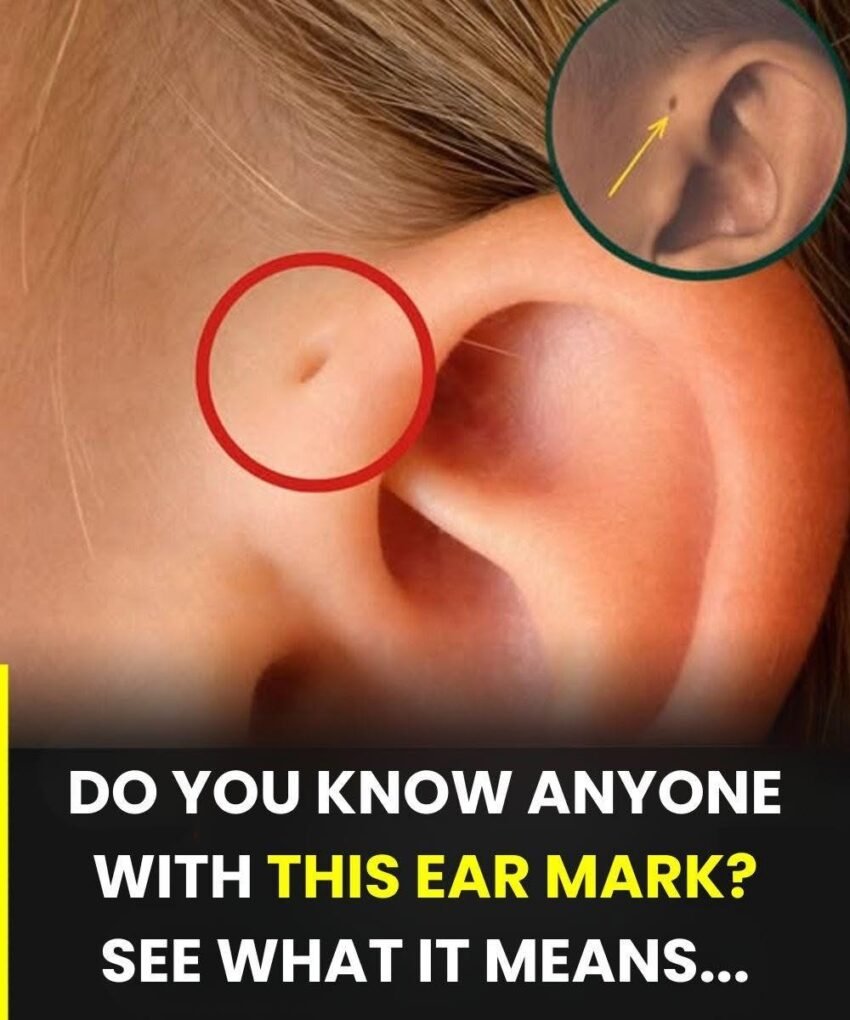
preauricular pit (or preauricular sinus)—a tiny hole or dimple right where the top of the ear meets the side of the face. And you’re correct: it’s not from an injury or a piercing gone wrong. It’s congenital.
What It Actually Is
A preauricular pit is a small, harmless malformation that forms during the sixth week of pregnancy. At that stage, the embryo is building the outer ear by fusing together small nodules of tissue called the “hillocks of His.” If they don’t fuse perfectly, a tiny sinus tract—essentially a narrow, blind-ended tunnel—remains. It can be shallow or surprisingly deep, and it usually occurs on one side, more commonly the right.
How Common Is It?
-
In the general global population: roughly 0.1% to 0.9% of people.
-
In certain populations (parts of Asia and Africa): up to 4% to 10%.
-
It’s often inherited in an autosomal dominant pattern, meaning if a parent has one, a child has about a 50% chance of having one too.
What It Might Mean: The Syndromic Link
For the vast majority—over 90% of cases—it’s isolated and completely meaningless for overall health. It’s just a quirky anatomical souvenir.
However, in a small percentage, it can be a very subtle marker for something more. The ear and the kidney develop at the same embryonic stage. Because of this shared developmental window, there’s a known association between preauricular pits and certain syndromes, most notably Branchio-Oto-Renal (BOR) syndrome.
If a preauricular pit is accompanied by these signs, it may indicate a need for further evaluation:
-
A branchial cleft cyst or skin tag on the neck
-
Hearing loss (conductive or sensorineural)
-
Kidney anomalies (from mild malformations to agenesis)
This is why, in a newborn with an isolated pit, many pediatricians will still perform a basic kidney ultrasound just to be sure—especially if there is any family history of hearing or kidney problems.
What It Is NOT
It is not a vestigial gill slit. That’s a persistent internet myth. All vertebrate embryos have pharyngeal arches and clefts at that stage; they go on to form the jaw, ear bones, and Eustachian tube—not functional gills. The “gill” framing is a profound misunderstanding of embryology.
It is also not a spiritual sign, a mark of good luck or wealth, or an indication of past-life injury—though many cultures have beautiful traditional beliefs attached to it.
Practical Care
Most people with a preauricular pit live their entire lives without a problem. The only two things to know:
-
Don’t poke it or squeeze it. The tract is lined with skin cells that produce oil and shed. Squeezing can push that material deeper and introduce bacteria.
-
Watch for infection. If it becomes red, swollen, tender, or oozes pus, it needs treatment—antibiotics first, and if infections recur, a minor surgical procedure to excise the entire tract.
Do you have one yourself, or did you notice it on a family member?