
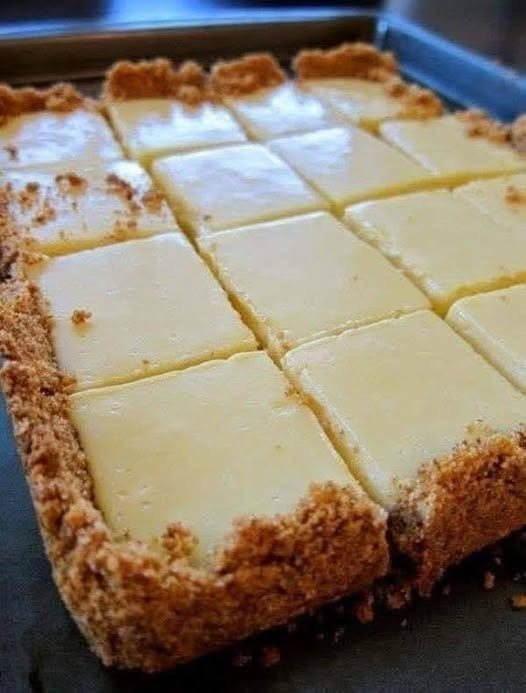
These aren’t just any lemon squares; the goal here is a texture so creamy and silky it almost resembles a lemon custard on a shortbread cloud, with a perfectly balanced tart-sweet flavor.
The secret is in the technique: a high ratio of fresh lemon juice to eggs, gentle baking, and proper cooling. This recipe delivers a bar with a crisp, buttery base and a smooth, never-gloopy, creamy topping.
The Ultimate Creamy Lemon Squares
For the Shortbread Crust
-
1 cup (2 sticks) unsalted butter, very cold, cut into small cubes
-
2 cups all-purpose flour
-
½ cup granulated sugar
-
¼ teaspoon salt
For the Creamy Lemon Filling
-
6 large eggs, at room temperature (this is crucial for a smooth texture)
-
2 ½ cups granulated sugar (this seems like a lot, but it balances a full cup of lemon juice)
-
1 cup freshly squeezed lemon juice (about 4-6 lemons; the brightness of fresh is non-negotiable)
-
1 tablespoon lemon zest (from the lemons above)
-
½ cup all-purpose flour (just enough to stabilize, not enough to make it cakey)
-
Powdered sugar, for a generous dusting
Method
1. Prepare the Shortbread Base
-
Preheat your oven to 350°F (175°C). Grease a 9×13-inch baking pan and line it with parchment paper, leaving an overhang on two sides for easy lifting.
-
In a food processor, pulse the flour, sugar, and salt. Add the cold butter cubes and pulse until the mixture resembles coarse, pebbly sand and just begins to stick together when pinched. (No food processor? Cut the butter in with a pastry blender or two forks.)
-
Press the crumbly dough firmly and evenly into the bottom of the prepared pan. It will seem dry, but trust the process.
-
Bake for 18-20 minutes, until the edges are lightly golden.
2. The Secret to a Creamy, Non-Bubbly Top
-
While the crust bakes, make the filling. Crucially, whisk by hand. Do not use an electric mixer. A mixer incorporates too much air, which causes the filling to puff up, then sink and crack as it cools. Hand-whisking guarantees a dense, silky, creamy custard.
-
In a large bowl, whisk the eggs just until uniform. Add the sugar and whisk until smooth and fully combined.
-
Add the lemon juice, zest, and flour. Whisk gently and patiently until the mixture is perfectly smooth and has no lumps of flour.
-
The No-Bubble Pour: Pour the filling through a fine-mesh strainer into a separate bowl or directly over the back of a spoon onto the hot crust. This catches any stray bits of chalaza (egg white cord) or unmixed flour, ensuring a perfectly smooth final texture.
3. Bake the Bars (Low and Slow)
-
Place the pan in the oven. Immediately reduce the oven temperature to 325°F (160°C). This gentler heat is key to a creamy, not rubbery, curd.
-
Bake for 22-25 minutes, or until the center is set but still has a slight, uniform jiggle like Jell-O when you gently shake the pan. It should not be liquid in the center. The edges will look set.
-
Critical Cooling: Place the pan on a wire rack and let it cool completely to room temperature. Then, refrigerate for at least 2 hours, or ideally overnight. This is non-negotiable. The bars slice cleanly and achieve their ultimate creamy fudge-like texture only when thoroughly cold.
4. Serve
-
Using the parchment sling, lift the entire block of lemon bars onto a cutting board. Use a sharp chef’s knife, wiping it clean between cuts for perfectly sharp edges.
-
Just before serving, pile a generous mound of powdered sugar into a fine-mesh sieve and dust the tops. (If you dust too early, the sugar will dissolve into the bars.)
These are the bars you make when you need a slice of sunshine—bright, intensely creamy, and a perfect counterpoint to all that talk of beets and floor cleaner. Let me know if you’d like a version with a toasted coconut crust or a dairy-free coconut cream twist.