
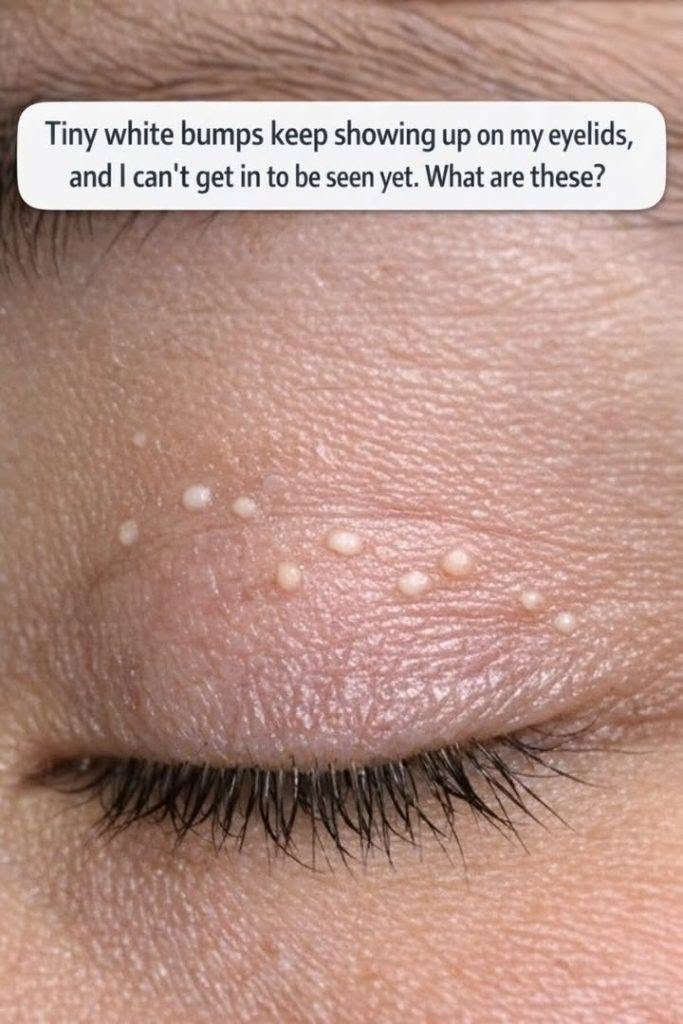
Seeing tiny white bumps appear on your eyelids can be frustrating and a little alarming, but the good news is that they are usually completely harmless and incredibly common.
If these bumps are small, hard, white or yellowish, and clustered around the eye area, you are almost certainly dealing with one of two things: Milia or Syringomas (and occasionally, tiny cholesterol deposits called Xanthelasma).
Here is a breakdown of what these bumps likely are, why they keep showing up, and how to safely get rid of them.
1. Milia (The Most Common Culprit)
If the bumps look like tiny, hard white pearls trapped just under the surface of the skin, they are likely milia.
What are they?
Milia are tiny cysts filled with a protein called keratin (the same protein found in hair and nails). They form when dead skin cells or keratin get trapped just beneath the surface of the skin. Unlike pimples, they are not caused by bacteria, are not inflamed, and do not have an opening to squeeze.
Why do they keep showing up on your eyelids?
The skin on your eyelids is the thinnest skin on your entire body. Because it is so delicate, it is easily irritated. Milia often form due to:
-
Heavy Eye Creams: Using thick, highly occlusive eye creams or oils can trap dead skin cells on this delicate area.
-
Sun Damage: Years of sun exposure thickens the skin, making it harder for dead cells to slough off naturally, trapping keratin underneath.
-
Friction: Rubbing your eyes frequently.
2. Syringomas (Sweat Duct Growths)
If the bumps are slightly flatter, soft to the touch, and appear in clusters symmetrically under both eyes, they might be syringomas.
What are they?
These are benign overgrowths of the sweat gland ducts. They are completely harmless, but unlike milia, they are a genetic trait and tend to run in families. They are more common in women and often show up during adolescence or middle age.
3. Xanthelasma (Cholesterol Deposits)
If the bumps are slightly yellowish, soft, and flat (often looking like a patch of yellow skin rather than a distinct pearl), they could be xanthelasma.
What are they?
These are deposits of cholesterol that collect under the skin. While they are harmless to the eye itself, they can sometimes be a warning sign of high cholesterol or lipid levels in your blood.
What You Should NOT Do
It is incredibly tempting, but do not pick, squeeze, or scratch at these bumps.
-
Unlike pimples, milia and syringomas have no “head” to pop.
-
Squeezing the delicate eyelid skin will only cause redness, swelling, broken blood vessels, scabbing, and potential scarring—but the bump will remain right where it was.
How to Safely Get Rid of Them
The hard truth is that once these bumps are formed, no over-the-counter cream, scrub, or home remedy will dissolve them (despite what TikTok might tell you). They need to be physically extracted or treated by a professional.
1. See a Dermatologist or Ophthalmologist
The best and safest solution is to have a professional remove them. This is a very quick, affordable, and virtually painless in-office procedure. They will likely use one of three methods:
-
Manual Extraction (Derofing): The doctor uses a sterile, tiny needle to make a microscopic nick in the skin and pops the keratin pearl out.
-
Electrocautery: A tiny probe uses heat to zap the bump off.
-
Laser Ablation: A focused laser precisely removes the bump without touching the surrounding skin.
2. Change Your Eye Cream
If you are currently using a very heavy, greasy eye cream, try switching to a lightweight, oil-free gel moisturizer. Look for products labeled “non-comedogenic.” This can help prevent new milia from forming.
3. Gently Exfoliate (But Carefully)
If you are prone to milia, incorporating a very gentle chemical exfoliant (like a low-percentage glycolic acid or salicylic acid pad) around the orbital bone—being careful not to get it on the actual eyelid—can help keep dead skin cells from building up.
When to See a Doctor Immediately
While the above conditions are cosmetic, you should call an eye doctor or dermatologist right away if the bump:
-
Is growing rapidly.
-
Is red, painful, or oozing pus (this could be a stye or an infection).
-
Is interfering with your vision.
-
Is accompanied by the eyelid becoming swollen or hot to the touch.
Disclaimer: I am an AI, not a doctor. If you are unsure what the bumps are, a quick visit to a dermatologist can give you peace of mind and a definitive treatment plan.