
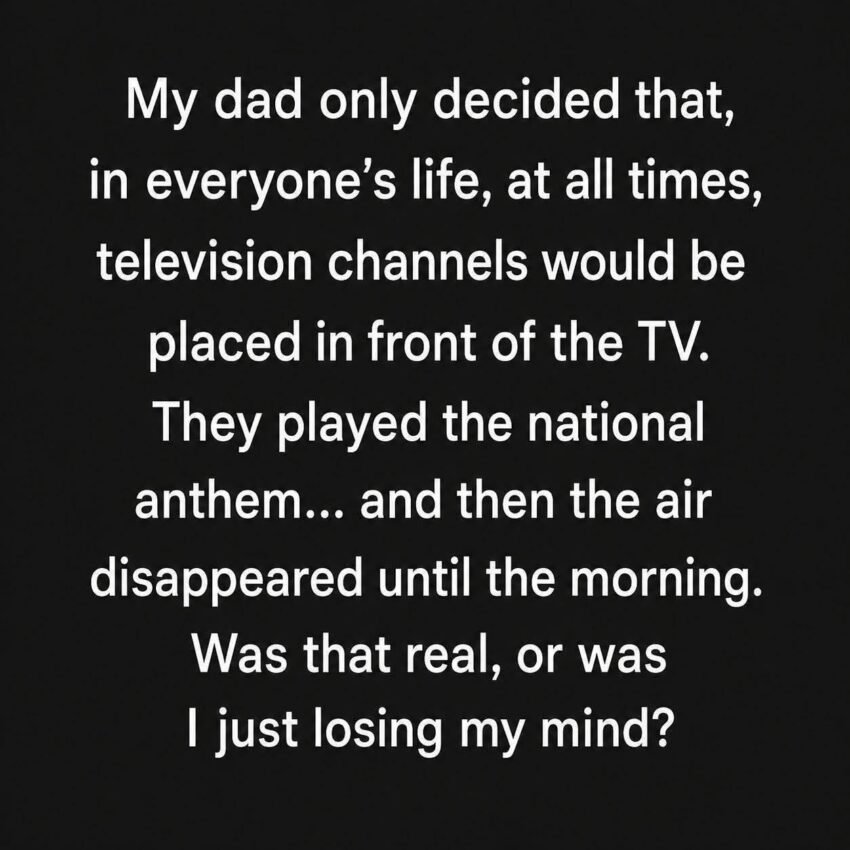
Yes, it is absolutely true! If you were to turn on a television at 2:00 AM in the 1950s, 60s, 70s, or even the 80s in some places, you wouldn’t find infomercials, reruns, or 24-hour news. Instead, you would likely be greeted by a test pattern, a steady high-pitched tone, and eventually, static (often called “snow”).
This was a standard practice known as the broadcast sign-off. Here is the fascinating history of why TV used to go to bed every night:
What Did the “Sign-Off” Look Like?
The end of the broadcast day was usually a formal, almost ceremonial event. It typically happened between midnight and 2:00 AM. The sequence usually went like this:
-
The Final Program: The station would play the national anthem. In the United States, this was often accompanied by patriotic footage (like jets flying in formation or flags waving).
-
The Station Announcement: A deep-voiced announcer would state the station’s call letters (e.g., “This is WXYZ-TV, Channel 7…”), list the station’s ownership, and sometimes read the technical specifications of their broadcast signal.
-
The Sermon/Thought for the Day: Some local stations had a minister offer a brief, non-denominational prayer or a motivational thought.
-
The Test Pattern: The station would cut to a static image known as a “test pattern”—most famously, the Indian-head test pattern—which allowed TV repairmen and engineers to calibrate the color, focus, and alignment of their TV sets during the day.
-
The Tone: A piercing, continuous 1,000 Hz audio tone would play for a few seconds.
-
Static: Finally, the transmitter was switched off. The screen would dissolve into a hissing, gray/black cloud of visual “snow” and white noise.
Why Did They Stop Broadcasting?
It might seem strange today, but in the early days of television, running a station 24 hours a day was highly impractical for several reasons:
1. There wasn’t enough money (Advertising).
Advertising in the middle of the night generated almost zero revenue. The audience was tiny, and advertisers didn’t want to pay for airtime when most people were asleep. It cost more to pay the electric bill, the overnight engineers, and the broadcast rights for the content than they could make back in ad revenue.
2. The equipment needed to rest.
Early television transmitters used massive, fragile vacuum tubes and high-voltage equipment. These machines generated immense heat and could burn out or catch fire if run continuously. Stations needed a few hours of “down time” every night for engineers to perform routine maintenance, fix glitches, and replace burnt-out components.
3. There was a severe lack of content.
In the 1960s, there were only a handful of channels, and they all relied on original programming. There was no market for “reruns” late at night. Once the evening news and The Tonight Show ended, there simply was nothing left to air. The idea of running B-movies or paid advertisements all night didn’t catch on until the 1980s.
The Transition to 24/7 Television
The shift happened gradually:
-
Cable TV (1980s): When cable networks like CNN (launched in 1980) and MTV (launched in 1981) arrived, they aggressively marketed the idea of being available “around the clock.” CNN famously branded itself as the network that never sleeps.
-
Infomercials (Mid-1980s): The government deregulated how much advertising could be shown per hour. Suddenly, creating 30-minute or 60-minute commercial blocks (infomercials) became incredibly profitable. Stations realized they could make more money airing cheesy ads for kitchen gadgets at 3 AM than they could airing old movies.
-
Late Night Programming: Networks realized there was an untapped audience of insomniacs, shift workers, and college students. NBC’s Late Night with David Letterman (1982) helped prove that people would watch TV at 12:30 AM.
By the late 1990s and early 2000s, the traditional “sign-off” had completely vanished from almost all major networks. Today, the only places you typically see this old-school practice are on very small, low-power local stations in rural areas or on some PBS member stations that go dark overnight.
It is one of those small cultural rituals that is completely lost on anyone born after 1990—the strange, almost romantic idea of the TV telling you “Goodnight,” and the screen going to sleep along with the rest of the country.