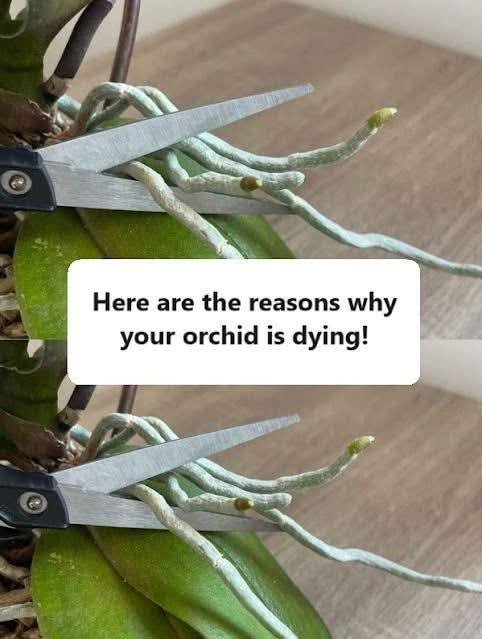
Orchids have a reputation for being finicky, but the truth is simpler and more tragic: they rarely die from neglect. They die from love. Too much water, too much concern, too much intervention.
If your Phalaenopsis (moth orchid) is yellowing, wilting, or dropping leaves, it is not “angry” at you. It is sending you a very specific botanical distress signal. Here is how to read those signals.
1. The Roots Are Silver or Brown (You Are Thirsting It to Death)
The myth: Orchids need one ice cube per week.
The truth: Ice burns tropical roots. Also, one cube is rarely enough.
Look at the roots:
-
Healthy: Plump, firm, green or silvery-green.
-
Dehydrated: Flat, shriveled, gray, or papery-white.
The fix: Submerge the entire inner pot in room-temperature water for 10–15 minutes once a week. Drain completely. Do not let water sit in the crown (the center where leaves meet). That causes rot.
2. The Leaves Are Limp and Yellow (You Are Drowning It)
This is the most common killer. Orchids are epiphytes. In nature, they grow on trees, their roots exposed to air. They are not soil plants. They suffocate in constant moisture.
Look at the roots:
-
Rot: Mushy, brown, black, stringy. These roots are dead.
The fix: Stop watering immediately. Unpot the plant. Cut away all mushy roots with sterile scissors. Spray the remaining roots with 3% hydrogen peroxide to kill bacteria. Repot in fresh orchid bark, not soil. Do not water for 5–7 days to let wounds callus.
3. The Leaves Are Dark Green, No Flowers (It Is Starving for Light)
Deep green leaves look healthy, but on a Phalaenopsis, they are a lie. Orchid leaves should be apple-green, not forest-green. Dark green means “I am so desperate for light I have produced excess chlorophyll to survive.”
The fix: Move it to a bright windowsill with no direct afternoon sun (east-facing is ideal). Morning sun is gentle; afternoon sun burns leaves like a magnifying glass.
4. The Leaves Are Wrinkled and Accordion-like (Inconsistent Watering)
If a leaf develops horizontal ridges or looks pleated, it experienced drought during growth. The tissue never fully expanded.
The fix: This damage is permanent. The leaf will not smooth out. But you can prevent it on new leaves by establishing a consistent rhythm. Orchids prefer being soaked and fully dried rather than sprinkled daily.
5. The Flower Spike Is Brown and Crisp (It Is Just Resting)
This is the only “death” that is not death. After blooming, orchids often drop flowers and the spike turns brown. This is dormancy, not dying.
The fix: Cut the brown spike all the way down to the base. Continue watering and feeding lightly. A new spike may emerge in 2–6 months. Patience is not optional; it is required.
6. The Crown Is Brown or Mushy (The Point of No Return)
If the center of the plant—the crown where new leaves emerge—turns brown or feels soft, the orchid has crown rot. This is almost always caused by water sitting in the crown after watering.
The fix: Immediate surgery. If there is any green tissue remaining, you can try to save it by dabbing the crown with 3% hydrogen peroxide and keeping it bone dry. If the entire crown is brown, the plant will not produce new leaves. It is terminal.
However: Do not throw it away yet. Sometimes a basal keiki (a baby plant) will emerge from the side of the pot. Keep caring for it. Orchids are stubborn.
7. The Pot Is Too Big (You Are Lonely Together)
Orchids like tight spaces. If you put a small orchid in a large pot, the bark stays wet too long, the roots rot, and the plant focuses on filling the pot instead of blooming.
The fix: Orchids should be in a pot just large enough to hold the root system. If you can fit more than two fingers between the roots and the rim, it is too big.
The Rescue Protocol (Summary)
-
Unpot. Remove all old bark.
-
Cut. Remove dead, mushy, papery roots. Keep firm roots even if they are thin.
-
Spray. Hydrogen peroxide on cuts. Let air dry 24 hours.
-
Repot. Fresh orchid bark. Clear pot with drainage holes (roots photosynthesize!).
-
Wait. No water for 5 days. Then soak weekly.
-
Light. East window.
-
Patience. Recovery takes months. New leaves first, then roots, then flowers.
A Final Thought
Orchids do not die to punish you. They die because we treat them like violets or succulents. They are neither. They are slow, deliberate creatures that measure time in months, not days.
If yours is dying, it is not too late. Cut away the rot, give it light and air, and wait. Often, that is all they ever needed.