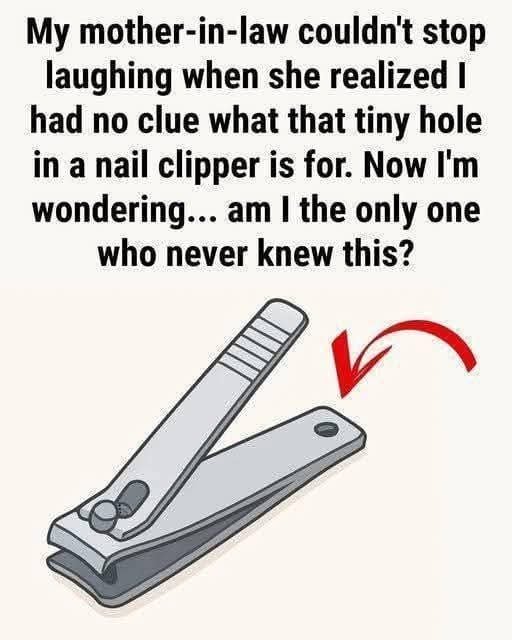
You have held a nail clipper thousands of times. You have squeezed the lever, caught the nail shavings, perhaps cursed when a sharp edge caught on a sock.
But that small round hole on the arm—the one opposite the cutting blade, the one that seems like a design afterthought or a keychain attachment—you have likely never used it for its intended purpose. And that is a shame, because it is a small piece of mechanical genius.
The Hole Is Not for Hanging
Let us dispel the myth immediately. Yes, you can thread a keyring through it. Yes, it functions as a way to keep your clippers on a hook. But that is not why it exists.
The hole is a built-in safety mechanism and a hygiene tool.
It has two distinct, powerful uses that most people never discover.
Use 1: The Catcher (The Obvious One You Missed)
When you clip your fingernails over a trash can, the nails bounce. They defy trajectory. They land on the bathmat, in the sink, on your pant leg. You spend more time hunting for shrapnel than actually grooming.
The fix:
Do not clip your nails over open air.
Instead, slide the small round hole over the nail before you clip.
-
Place the clipper blade over the nail edge.
-
Slide the round hole directly under the tip of the nail you are about to cut.
-
Squeeze.
What happens: The nail does not fly. It is caught, cleanly and quietly, inside the hole. The hollow chamber traps the shaving. You then tilt the clipper and deposit the nail directly into the trash.
This is not a trick. This is how the tool was designed to function. The hole is not an afterthought; it is a containment vessel.
Use 2: The Emergency Filed Edge (The One That Might Save Your Day)
You are traveling. You are in a hotel room, a conference room, a car. You snag a fingernail on something—a piece of tape, a rough edge of luggage, a paper cut waiting to happen. The nail has a jagged, sharp corner that will catch on everything.
You do not have an emery board. You do not have a file.
The fix:
Take your nail clipper. Look at the small round hole.
The inner circumference of that hole is not smooth. It is machined with a slight, sharp edge—a residual ridge from the stamping and manufacturing process.
Insert the jagged edge of your fingernail into the hole. Tilt it slightly. Drag the nail along the inner rim in one direction, as if you were using a match to strike a flint.
What happens: The rough inner edge acts as a micro-file. It will smooth the jagged edge in three or four passes. It will not give you a salon-grade finish, but it will stop your nail from catching on silk blouses and wool sweaters.
This is not a myth. This is metallurgy repurposed as grooming.
The Mechanical Logic
Why does this hole exist if no one knows about it?
Nail clipper design has remained largely unchanged since the 1890s, when the modern pivoting clipper was patented. The hole serves a dual purpose in the manufacturing process:
-
It reduces material weight and cost without compromising structural integrity.
-
It creates the rough inner edge that allows for the filing function.
The “nail catcher” use was either intentional from the beginning or a happy accident discovered by a factory worker a century ago. We do not know for certain. But it works.
Two More Things That Hole Can Do
3. Stabilizing the clipper for toenails:
If you have limited hand strength or arthritis, you can insert a toothpick or small Allen wrench into the hole, creating a makeshift extension handle. This gives you more leverage and reduces the force required to cut thick toenails.
4. Holding the clipper closed:
If you slide the lever of the clipper through the hole, you can lock the clipper in a closed position. This protects the blades and prevents it from snagging in a drawer or bag.
The Deeper Lesson
We live in an era of planned obsolescence. Tools are designed to be replaced, not understood. The nail clipper is a relic of a different philosophy—a simple machine built from stamped metal, two levers, and a rivet. It has no electronics, no batteries, no proprietary components.
And hidden in plain sight, on the arm of this everyday object, is a feature that 99% of users never discover.
It is a quiet reminder: Look closer. The tools you own are smarter than you think.
The hole is not empty. It is waiting.