
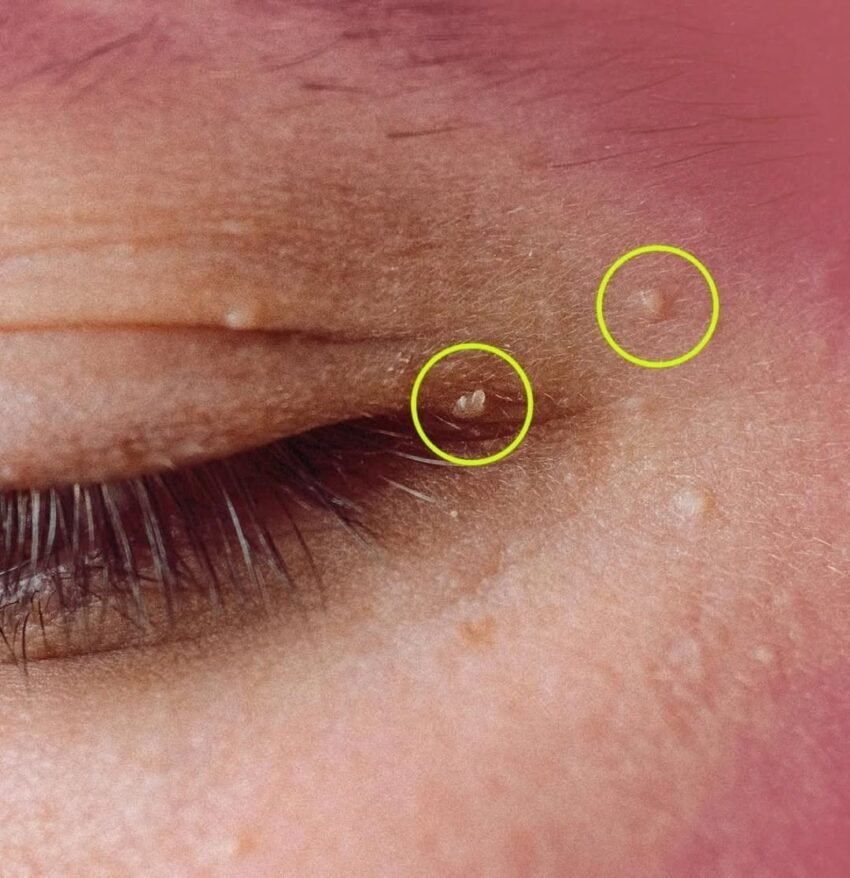
The crucial thing to understand first is that milia are not pimples or traditional “fat cysts.” They are tiny cysts filled with keratin (a skin protein), not sebum (oil). This is why you can’t just pop them like a whitehead; there’s no opening, and the contents are solid, not liquid.
Trying to squeeze them yourself is the number one mistake and will only lead to scarring, inflammation, and broken capillaries. Here’s the correct, dermatologist-recommended path from safest at-home care to professional removal.
What NOT to Do (The Golden Rule)
-
Do not squeeze, pick, or poke with a needle at home. Milia are covered by a thin layer of skin. You cannot extract the hard keratin plug without making a precise opening with a sterile lancet. DIY attempts cause trauma, infection, and permanent scarring.
-
Do not use heavy, occlusive eye creams. Thick, greasy creams are a primary cause of milia around the eyes. They trap keratin and dead skin cells.
Level 1: At-Home Treatment (The Gentle, Preventative Route)
This won’t remove existing deep milia overnight, but over weeks it can bring them to the surface naturally and, more importantly, prevent new ones from forming. This is the only safe method for the delicate skin around the eyes.
1. Exfoliate with the Right Chemicals (Not Gritty Scrubs)
Physical scrubs are too harsh and won’t reach the pore-like pocket. You need chemical exfoliants that dissolve the glue holding dead skin cells together.
-
Salicylic Acid (BHA): This is oil-soluble, so it can penetrate into the pore lining to dissolve the keratin plug. Use a 2% salicylic acid cleanser or leave-on toner a few times a week.
-
Glycolic Acid (AHA): A water-soluble exfoliant that loosens the dead skin layer covering the milia. A 5-7% glycolic acid toner used at night can be very effective, but be cautious near the eyes.
-
The Gold Standard for Prevention: Retinoids. Over-the-counter retinol or prescription tretinoin speeds up skin cell turnover, preventing dead cells and keratin from getting trapped in the first place. This is your long-term prevention hero. Start with a low strength (0.25% or 0.5%) twice a week and apply a tiny amount, carefully avoiding the immediate eye area but treating the orbital bone.
2. The “Warm Compress” Myth vs. Reality
A warm compress won’t dissolve the cyst, but gentle daily heat can help soften the skin’s surface and might encourage a very superficial milium to spontaneously release with your normal facial cleansing. Use a clean, warm, damp cloth and hold it against the area for 5 minutes daily. Do not rub or scrub.
Level 2: Targeted Over-the-Counter Spot Treatments
These are stronger and require precision. Use a cotton swab to apply them only to the milia bump.
-
Retinoid Spot Treatment: Apply the tiniest dab of your OTC retinol serum directly on the milium each night. The goal is to slowly thin the skin covering it until the plug pops out.
-
High-Concentration Acid Peeling Solution: A 9% salicylic acid solution or a glycolic acid peel pad used as a spot treatment can aggressively exfoliate the cap of skin. Use extreme caution and stop if you get any redness or irritation.
Level 3: Professional In-Office Procedures (The Real Solution)
If you want them gone quickly and safely, especially around the sensitive eye area, a dermatologist or licensed aesthetician is your best bet. It’s fast, nearly painless, and minimizes scarring risk.
-
Lancing and Extraction: The most common and immediate method. The professional uses a tiny, sterile needle or a no. 11 surgical blade to create a microscopic nick in the skin over the cyst. They then use a comedone extractor to gently press out the hard, white, pearl-like keratin core. It’s over in seconds.
-
Cryotherapy: Liquid nitrogen is used to freeze the milia spot, causing the cyst to crust over and fall off naturally. Not always the first choice near the eyes.
-
Electrocautery: A tiny, heated probe gently zaps the milia, destroying the cyst wall. Again, a precise procedure for a professional.
Milia-Specific Prevention Routine
If you’re prone to them, these are the key changes to make:
-
Switch to a Gel-Based Eye Cream: Look for oil-free, non-comedogenic formulas with hyaluronic acid instead of petrolatum, mineral oil, or lanolin.
-
Keep Your Sunglasses Clean: The friction from dirty glasses frames rubbing on your nose and cheeks can trap keratin.
-
Double Cleanse: If you wear heavy makeup or sunscreen, an oil cleanser followed by a water-based cleanser ensures all pore-clogging residue is gone.
-
Pat Don’t Rub: When applying eye cream or concealer, pat gently instead of rubbing, which can damage the pore openings.