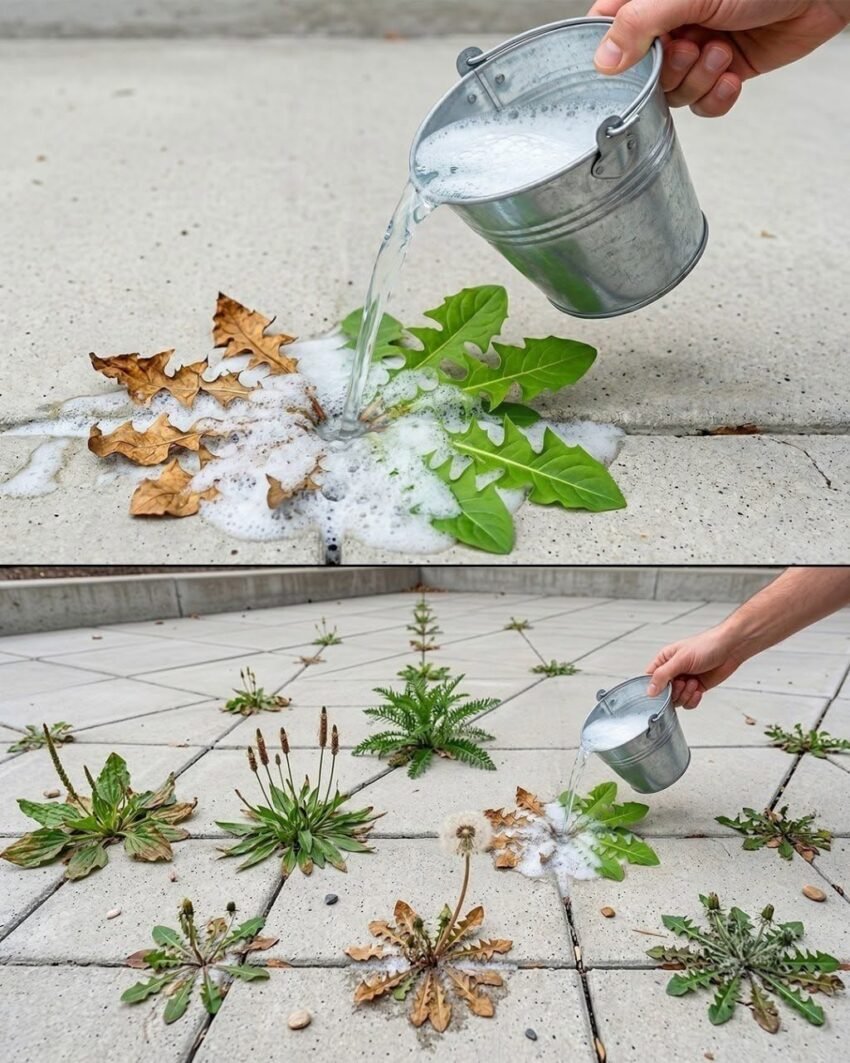
The most effective homemade weed killer relies on straightforward chemistry that desiccates plant tissue on contact. The classic, powerful formula uses common household ingredients to destroy the waxy cuticle protecting the weed’s leaves, causing it to rapidly dehydrate and die.
It’s crucial to understand that this is a non-selective, contact herbicide. It will kill or severely damage any plant it touches, so precision in application is everything.
Here is the strongest, most reliable homemade formula and exactly how to use it.
The Most Powerful Homemade Weed Killer
Ingredients:
-
1 gallon (3.78 L) white vinegar (Crucially, you need horticultural vinegar with 20-30% acetic acid for truly effective, fast results on tough perennial weeds. The standard 5% kitchen vinegar will work on young, tender annual weeds but will struggle with established ones.)
-
1 cup (approx. 270 g) table salt (Sodium chloride. Plain, cheap table salt is perfect. Epsom salt is not the same and won’t work.)
-
1 tablespoon (15 ml) liquid dish soap (Acts as a surfactant. It breaks the surface tension of the vinegar, allowing the solution to coat and stick to the waxy leaves instead of beading up and rolling off.)
Method:
-
Combine: Pour the salt into the vinegar and stir or shake vigorously for several minutes until as much salt dissolves as possible. A small amount of undissolved salt is normal. Add the dish soap and stir gently to combine without creating excessive suds.
-
Transfer: Pour the solution into a dedicated garden sprayer or a spray bottle. Label it clearly. Do not use a sprayer that has held other chemicals, and never use this sprayer for anything else afterward, as salt residue is corrosive and persistent.
-
Apply with Precision (The Critical Step):
-
Apply on a hot, dry, sunny, windless day. The sun activates and accelerates the desiccation process. No rain should be forecast for at least 24-48 hours.
-
Spray the weed’s leaves and stem thoroughly until the solution drips off, but without creating puddles in the surrounding soil.
-
Use a piece of cardboard or a plastic shield to protect desired plants from even the slightest drift of mist. This formula will not distinguish between a dandelion and a prized rose.
-
What to Expect:
-
Within 2-3 hours: You will see visible wilting and curling of the leaves on young weeds.
-
Within 24-48 hours: The entire plant should be brown, crispy, and clearly dead.
-
Stubborn, perennial weeds with deep taproots (like mature dandelions or thistles) may require a second, targeted application to fully kill the root, though the top growth will die back rapidly.
The Mechanism: Why This Works
This is not a gentle, organic method that slowly alters the weed’s metabolism. It is a direct chemical assault on the plant’s structure.
-
Acetic Acid (Vinegar): The high-concentration acid instantly burns and strips away the protective waxy cuticle on the leaf surface. This is the plant’s primary defense against water loss. Once that barrier is destroyed, the internal cells are exposed and rapidly evaporate their moisture.
-
Sodium Chloride (Salt): Once the cuticle is breached, salt acts as a powerful desiccant. Through osmosis, it draws water out of the plant’s cells directly, dehydrating them at a cellular level. The salt that soaks into the soil creates a “toxic zone” where seeds and roots cannot uptake water, providing a longer-term, albeit localized, soil sterilization effect.
The Critical Warnings and Limitations
This formula must be used with full awareness of its long-term consequences.
-
It Sterilizes Soil: Salt does not break down or evaporate. It washes deeper into the soil with rain and irrigation. After repeated use in the same area, the sodium concentration will build to levels toxic to most plants. Never use this formula in garden beds, near tree roots, or anywhere you intend to plant in the future. It is best suited for the cracks of driveways, patios, paths, and gravel areas where you never want anything to grow.
-
It Is Non-Selective: It will kill grass, flowers, shrubs, and beneficial insects like ladybugs or bees if they are sprayed directly. The soap can also suffocate soft-bodied insects. Apply with surgical precision.
-
It Does Not Discriminate by Root System: Perennial weeds with vast, interconnected root systems (like bindweed or Japanese knotweed) will often resprout from untouched roots. This spray will kill the visible foliage, weakening the root system over time with repeated applications, but it is not a systemic herbicide that travels to and kills the entire root network in one treatment.
Safer Alternatives for Garden Beds
If you need a non-toxic, non-soil-sterilizing control for weeds in your lawn, vegetable garden, or flower beds, you must use a different approach:
-
Boiling Water: This is the simplest, most effective, and genuinely safe method for spot-treating weeds in the garden. Pour carefully from the kettle directly onto the crown of the weed. It instantly cooks the plant and its cells burst. It leaves zero chemical residue in the soil. It will kill anything it touches, so aim carefully. It’s excellent for weeds in patios and path cracks as well.
-
Manual Removal: The most underrated method. Water the area deeply an hour before to loosen the soil, then use a hori-hori knife or a specialized weed puller to extract the entire taproot. This is the only way to guarantee certain perennial weeds are gone.
-
Smothering with Mulch: A thick 4-6 inch layer of wood chips, straw, or cardboard blocks sunlight completely. Weeds underneath will etiolate (grow pale and weak) and eventually exhaust their energy reserves and die. This method improves soil health as it works.
The powerful vinegar-salt-soap formula has its place for permanently clearing paths and patios, but it’s a tool of last resort in a living garden. Boiling water and a good weed knife are often the smarter, safer choices for the soil you care about.