
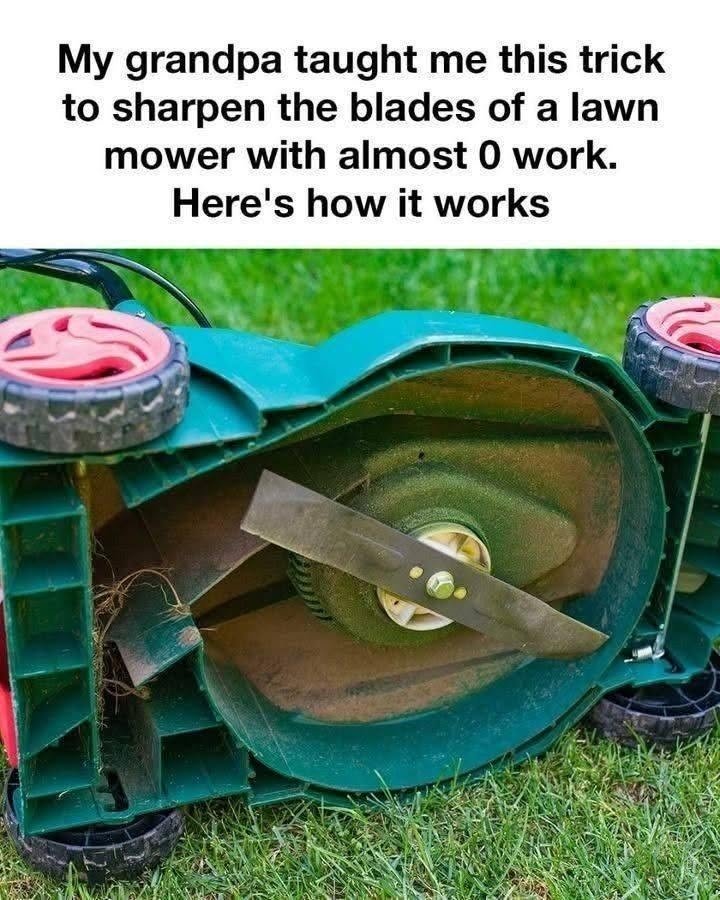
A sharp blade cleanly slices the grass, leaving a healthy cut that resists disease. A dull blade hammers and shreds the tips, turning them white and frayed and leaving your lawn vulnerable to fungus.
Most people overcomplicate this or pay a shop to do it. Here is the simple, safe trick that requires no special tools.
The “No-Vice, No-Angle-Finder” Trick: The Sharpie Belt Method
The biggest hurdle for a homeowner is holding the blade steady and finding the correct factory angle. This trick solves both.
What You Need:
-
A lawn mower blade (removed from the mower)
-
A standard mill file (10-12 inches, bastard cut)
-
A bench vise (or a sturdy C-clamp and a solid work surface)
-
A black Sharpie marker
-
Heavy leather gloves
-
A 2×4 block of wood (optional, for torque if you don’t have a vise)
Step 1: Secure the Blade (The No-Vise Workaround)
-
With a Vise: Clamp the blade securely in a bench vise with the cutting edge facing up and toward you. This is the ideal setup.
-
Without a Vise: Use a large C-clamp to fix the blade flat against the edge of a solid workbench or picnic table. If you have neither, place the blade on a flat concrete step, step on the flat center section with your boot to pin it down, and file the elevated end. Safety is paramount—wear heavy gloves in all scenarios.
Step 2: The Sharpie Reveal (This Is the Trick)
Don’t guess the angle. The factory edge is still there, just dull. Take your black Sharpie and completely color in the last ½ inch of the entire cutting bevel on one end of the blade. Color it solid black. This is your visual guide.
Step 3: Match the Factory Angle
Place your file against the blackened bevel. Adjust the angle of the file until you feel it sit flat against the existing metal. This is your angle. Your only job now is to push the file across that edge until all the black marker is gone. The Sharpie will tell you instantly if you’re holding the file at the wrong angle, because you’ll leave black ink in the low spots. File in one direction only (downward stroke on the diagonal), lifting the file on the return.
Step 4: The 10-Stroke Rule for Balance
This is the second part of the trick that saves your mower’s engine. Count your file strokes. Do roughly 10-15 firm, even strokes on one side, and then flip the blade and do the exact same number on the other. A severely out-of-balance blade will vibrate like a jackhammer and destroy the crankshaft bearing over time.
Step 5: The Balance Test (No Fancy Cone Needed)
Hang the blade by its center hole on a nail driven into the wall. If one side dips, that side is heavier. Remove a tiny bit more metal from the back of the heavy side’s cutting edge (not the sharp edge) with your file until it hangs level. A perfectly balanced blade will stand still, or float horizontally.
Step 6: Do Not Sharpen a Knife Edge
You want this blade to be “butter-knife sharp,” not “chef-knife sharp.” A razor-thin edge will curl and dent the instant it hits dirt or a small twig. After your file work, you should have a visible, flat “land” about the thickness of a dime on the very edge. It should bite into your fingernail but look durable.
How Often Should You Sharpen?
A good rule is every 20-25 hours of run time. For most homeowners, that’s twice a season: once at the start, and once mid-summer. A quick visual check after each mow is the real secret; if the cut grass tips are ragged and white, you’ve waited too long.
This is a ten-minute job that will make your mower run easier, use less gas, and make your lawn look like it was cut with a reel mower. Do this, and you’ll immediately hear the difference—a quiet, clean “swoosh” instead of a laboring rumble.