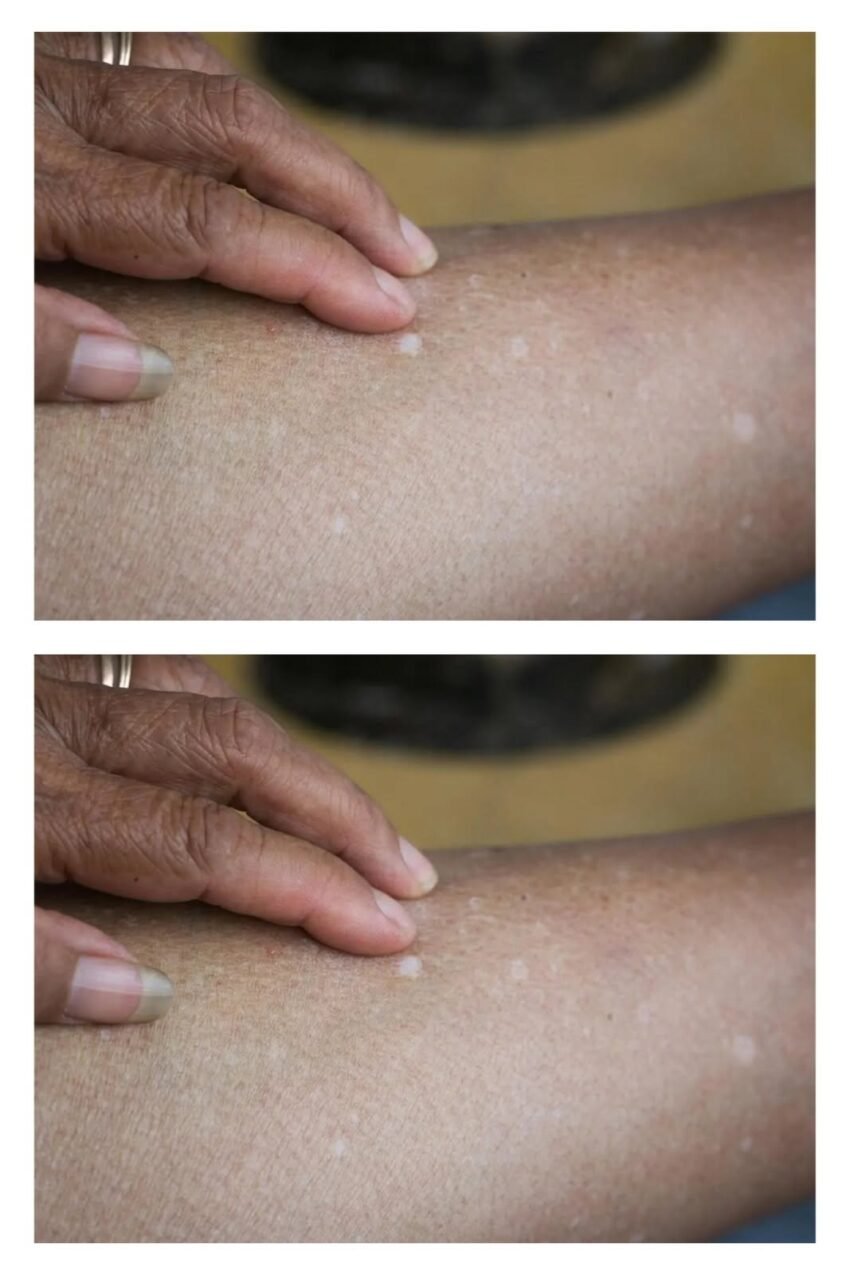
Let’s demystify Idiopathic Guttate Hypomelanosis (IGH) right away. The most important thing to know is that this condition is completely harmless.
Here is the plain-English breakdown of what IGH actually is, what the “first symptoms” look like, and why that scary headline is pure clickbait.
What is Idiopathic Guttate Hypomelanosis (IGH)?
Let’s break down the name itself, as it tells the whole story:
-
Idiopathic: The cause is unknown.
-
Guttate: From the Latin word for “drop,” meaning the spots look like small raindrops or splashes.
-
Hypomelanosis: “Hypo” means less, and “melanin” is skin pigment. So, it’s an area of skin with less pigment.
In simple terms, IGH is the medical name for the small, flat, white spots that commonly appear on sun-exposed skin as people age. It’s an extremely common and totally benign cosmetic condition.
The “First Symptoms” (What You Actually See)
There are no physical sensations or systemic symptoms. The “first symptoms” are purely visual:
-
Tiny, Flat White Spots: The most classic sign. They are usually 1 to 3 millimeters in size but can grow to be larger (up to 10mm). They are perfectly flat and feel exactly like the surrounding normal skin.
-
Location on Sun-Exposed Skin: The spots almost exclusively appear on the forearms and shins. They can also show up on the face, neck, and upper back/shoulders—areas with the most cumulative sun exposure.
-
Sharply Defined Borders: Unlike a rash, these spots have very clear, crisp edges where the white area stops and the normal skin begins.
-
No Pain, Itching, or Scaling: This is the key feature. If the white spots are itchy, scaly, or raised, it is not IGH. It could be something else like a fungal infection (tinea versicolor), eczema, or another condition that needs treatment.
Why the Headline Is Misleading
A headline implying you need to urgently watch for the “first symptoms” of IGH is like warning you about the “first signs” of a wrinkle or a gray hair. It causes unnecessary anxiety.
Here’s what that headline won’t tell you:
-
It’s Not a Disease: IGH is a benign pigmentary change, not a sickness. It does not turn into skin cancer.
-
It’s Extremely Common: It’s estimated that up to 80% of the population over 70 has it, and it can start much earlier, especially in women and people with fair skin.
-
It’s Caused by Sun and Aging: The most accepted scientific theory is that it’s a result of chronic, cumulative sun damage and the natural aging process, which reduces the number of melanocytes (pigment-producing cells) in small patches.
What To Do If You See These Spots
-
Get a Diagnosis for Peace of Mind: The only reason to see a dermatologist for these spots is to confirm the diagnosis. A doctor can easily distinguish IGH from other white spots, like vitiligo (which has a different distribution and progression) on sight, often using a Wood’s lamp.
-
Protect Your Skin to Prevent More: Sun protection is the only proven preventive measure. Using sunscreen and covering up will slow the appearance of new spots.
-
Treatment Is Optional and Cosmetic: Since it’s harmless, treatment isn’t necessary. If you want to reduce the appearance for cosmetic reasons, a dermatologist can discuss options like topical steroids, tretinoin, or laser treatments, but results are often modest.
Bottom line: The headline you saw is trying to make a purely cosmetic, age-related sun spot sound like a dangerous disease. It’s not. It’s just one of the many normal, harmless changes that come with time and sun exposure.