
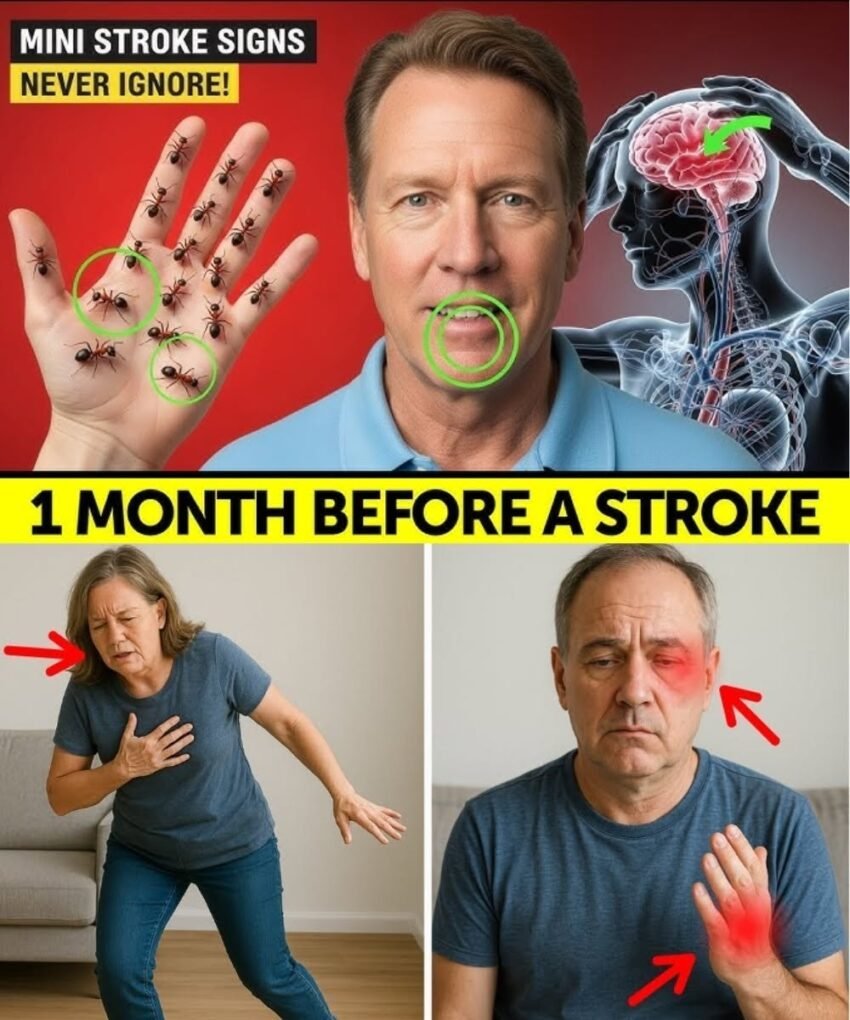
It’s important to understand upfront: the term “warning signs a month before” usually refers to a Transient Ischemic Attack (TIA) , often called a “mini-stroke.” A TIA is a temporary blockage of blood flow to the brain. The symptoms are identical to a stroke but usually last only a few minutes to hours, resolving completely within 24 hours.
A TIA is a medical emergency and a critical warning sign—about 1 in 5 people who have a TIA will have a full stroke within 90 days, often within the first 48 hours.
Here are 10 subtle signs you may notice in the days or weeks leading up to a major stroke:
1. Sudden, Severe “Thunderclap” Headache
Unlike a typical tension headache, this feels like the worst headache of your life, coming on instantly with no obvious cause. In the weeks prior, some people experience smaller “sentinel” headaches—brief, severe pains that resolve quickly, which can indicate a leaking or ballooning blood vessel.
2. Transient Facial, Arm, or Leg Numbness
You might feel a “pins and needles” sensation or complete numbness, typically on one side of the body. During a pre-stroke TIA, you might wake up with a “dead arm” that goes back to normal after shaking it out, or notice your face feels frozen briefly.
3. Brief Episodes of Confusion or Cognitive Fog
Suddenly, you can’t understand what someone is saying, or you feel disoriented in a familiar place. A person might be mid-sentence and suddenly forget what they were talking about, or struggle to understand simple instructions, only to feel completely normal 10 minutes later.
4. Temporary Vision Problems in One Eye
Known as amaurosis fugax, this feels like a dark shade or curtain being pulled down over one eye, then lifting minutes later. Some people experience sudden blurred vision, double vision, or a brief loss of depth perception. This occurs because the tiny blood vessels feeding the eye are blocked.
5. Sudden Slurred Speech or Difficulty Finding Words
You know exactly what you want to say but your mouth won’t form the words, or your speech sounds garbled and drunk to others. This is a classic TIA symptom. You might pick up the phone, try to speak, and produce gibberish, only to have it clear up before you hang up—this is a definite red alert.
6. Unexplained Dizziness or Vertigo
If the stroke risk is in the brainstem, you might feel a sudden spinning sensation (vertigo) or a lack of coordination, as if you’re walking on a boat. Unlike benign vertigo, brainstem TIA dizziness often comes with double vision, numbness, or slurred speech, and it happens regardless of head movement.
7. Sudden, Unprovoked Hiccups with Chest Pain
This is a red flag specific to women and posterior circulation strokes. Persistent, painful hiccups that won’t stop, combined with mild chest discomfort or nausea, can signal a blockage in the base of the brain affecting the breathing and heart centers. These are often misdiagnosed as indigestion or anxiety.
8. Unexplained Falls or Leg Buckling
Your leg might suddenly give out without warning, a symptom known as a “drop attack.” You didn’t trip on an object; your brain simply lost communication with your leg muscles for a split second, causing you to collapse, but you regain strength immediately after.
9. Sudden Fatigue and Swallowing Difficulty
An overwhelming, floor-hitting exhaustion that isn’t relieved by rest. You might also notice you’re coughing or choking slightly when drinking water, or your voice sounds suddenly hoarse and “wet.” This can indicate tiny clots affecting the brainstem’s control over the throat muscles.
10. Loss of Coordination in the Hands
You might suddenly drop your coffee mug for no reason, be unable to button your shirt, or find that your handwriting becomes illegible for a few minutes. This sudden clumsiness, usually isolated to one hand, occurs because blood flow to the cerebellum (the coordination center) is temporarily blocked.
What To Do Immediately (The B.E. F.A.S.T. Check)
If you or someone near you experiences any of these symptoms—even if they disappear completely—do not wait. Up to 43% of stroke patients experience TIA symptoms the week before a major stroke.
Use the B.E. F.A.S.T. acronym:
-
Balance: Sudden loss of balance?
-
Eyes: Sudden vision loss or double vision?
-
Face: Ask them to smile. Does one side droop?
-
Arms: Ask them to raise both arms. Does one drift down?
-
Speech: Ask them to repeat a simple phrase. Is it slurred or strange?
-
Time: Call emergency services immediately. Do not drive to the hospital yourself; paramedics can begin lifesaving treatment en route.
Disclaimer: This information is for educational purposes only and is not a substitute for professional medical advice. If you suspect a stroke or medical emergency, call your local emergency number immediately.