
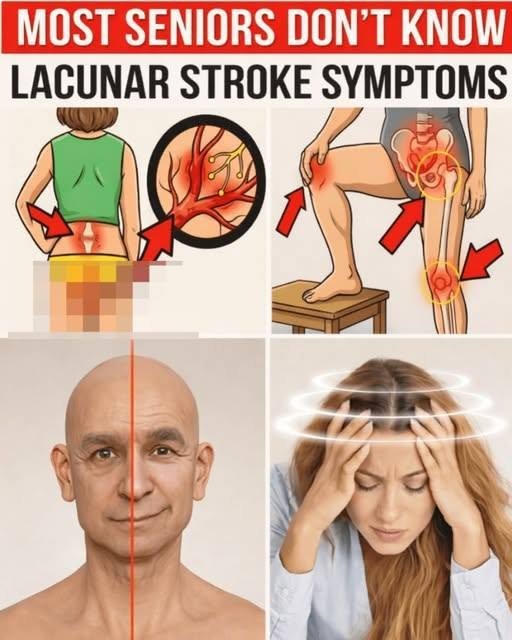
7 Lacunar Stroke Warning Signs in People Over 60 That Everyone Overlooks (Especially #4)
When we think of a stroke, we picture the dramatic Hollywood version: the sudden collapse, the slurred speech, the drooping face. But there is a far sneakier, quieter type of stroke that affects millions of seniors, often without them ever realizing it is happening.
It is called a lacunar stroke (or lacunar infarct).
Unlike a massive stroke that blocks a major artery, a lacunar stroke occurs deep within the brain structures when tiny, penetrating blood vessels become blocked. Because the affected area is small, the initial symptoms can be subtle. However, repeated lacunar strokes are a leading cause of vascular dementia, mobility issues, and cognitive decline.
For people over 60, the warning signs are often dismissed as “just getting older,” arthritis, or tiredness. Here are seven overlooked warning signs of a lacunar stroke, with the fourth one being the most easily ignored.
1. The “Clumsy” Hand
We all drop our keys from time to time. But if you or a loved one suddenly finds it difficult to button a shirt, write legibly, or manipulate small objects with one hand, take note.
Lacunar strokes often affect the motor pathways in the brain. This doesn’t result in paralysis necessarily, but rather a loss of fine motor control. Many people chalk this up to arthritis or neuropathy, but if the clumsiness comes on over a period of hours or days—rather than months—it is a red flag for a vascular event.
2. Walking Like You’re Tipsy (Without the Alcohol)
A specific type of lacunar stroke affects the brain’s balance centers. Sufferers often report feeling “wobbly” or having a wide-based gait. They may bump into door frames or feel unsteady on their feet.
Because seniors are often warned about balance issues due to inner ear problems or muscle weakness, this sign is frequently overlooked. The medical term is ataxic hemiparesis—weakness combined with a lack of coordination on one side of the body. If the unsteadiness is paired with a slight dragging of one foot, it demands immediate imaging.
3. Slurred Speech That Sounds Like Mumbling
Unlike a major stroke that renders someone mute or profoundly confused, a lacunar stroke in the internal capsule can cause dysarthria—a condition where the muscles used for speech are weak.
The person can still form sentences and understand language, but their words sound slurred, as if they have marbles in their mouth or have had a drink. Family members often tell them to “speak up” or assume their dentures are loose. If speech becomes suddenly thick without a dry mouth, it is a mini-stroke warning.
4. The “Absence” of Mood (Apathy and Depression)
This is the one everyone misses. When we think of stroke, we think of physical deficits. But lacunar strokes frequently strike the basal ganglia and frontal lobe connections—the areas responsible for motivation and emotion.
A person who has suffered a silent lacunar stroke may not look sick. They may simply stop caring. They lose interest in hobbies, stop calling grandchildren, or sit staring at the television for hours without really watching it.
Doctors often diagnose this as late-life depression or dementia. However, vascular depression (depression caused by poor blood flow to the brain) is a specific medical condition. If a previously engaged, cheerful senior suddenly becomes apathetic, flat, or emotionally withdrawn over a short period, it isn’t just “the blues”—it could be a series of tiny strokes cutting off the blood supply to the mood centers of the brain.
5. Urinary Incontinence (The Unspoken Symptom)
It is a topic people avoid, but it is a critical neurological sign. The brain controls the bladder through a complex network of signals. If a lacunar stroke hits the areas that inhibit bladder contractions, the result is sudden urgency or incontinence.
If a senior who has been toilet-trained for 70 years suddenly starts having accidents or has to rush to the bathroom with no prior warning, and there is no urinary tract infection (UTI) present, the brain should be examined. The bladder isn’t failing; the brain is failing to send the “hold it” signal.
6. The “Fuzzy” Headache
We are told that strokes are associated with the “worst headache of your life.” Lacunar strokes often don’t do that. Instead, they can produce a vague, persistent fuzziness or a mild pressure in the head.
Because lacunar strokes are often caused by chronic high blood pressure, the headache may be mistaken for a tension headache or a blood pressure spike. It is usually not severe enough to send someone to the ER, but it is a warning that the small vessels in the brain are under stress.
7. Cognitive “Stutter” (Processing Delays)
This is not memory loss in the Alzheimer’s sense. It is a slowing down of the processing speed. A senior might struggle to follow a fast-paced conversation, or they may take much longer to solve a simple problem (like splitting a restaurant bill).
Family members often describe it as, “Dad is just slowing down.” However, when the white matter of the brain is damaged by multiple tiny lacunar strokes, the brain’s “wires” are cut. The information is still there, but it travels slowly. If the thinking speed drops noticeably over a matter of weeks, it is a sign of vascular damage.
The Bottom Line
Lacunar strokes are closely linked to hypertension and diabetes. If you are over 60, the best way to prevent these sneaky symptoms is to aggressively manage your blood pressure. If you recognize #4, or any combination of these symptoms in yourself or a loved one, do not wait for them to “snap out of it.”
Ask for a CT scan or MRI specifically looking for small vessel ischemia. Time is brain, even when the damage is tiny.