
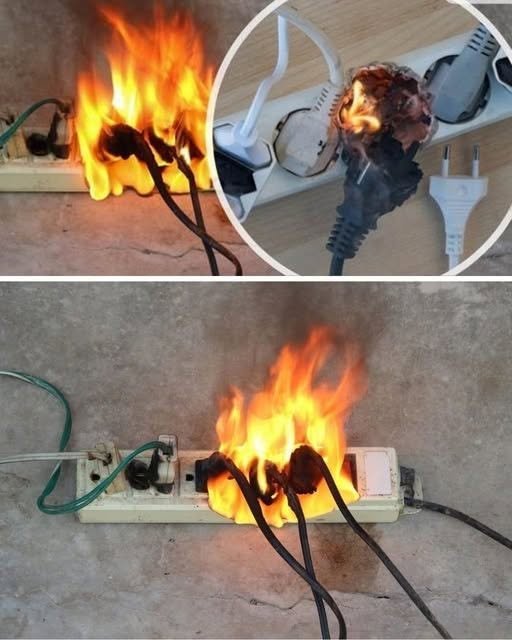
Here are 9 things you should never plug into a power strip — and why doing so can be a serious fire or electrical hazard.
1. Space Heaters
Space heaters draw a huge amount of power, often 1,500 watts or more.
Power strips are not designed to handle that kind of sustained load. They can overheat, melt, and catch fire.
Rule: Always plug space heaters directly into a wall outlet.
2. Air Conditioners
Portable and window air conditioners also pull heavy current, especially when the compressor starts.
This can overload a power strip quickly, causing it to overheat or trip.
Rule: Plug air conditioners directly into a dedicated wall outlet.
3. Microwave Ovens
Microwaves use a lot of electricity in short bursts.
Even though they don’t run constantly, they can exceed the power strip’s rating and cause overheating over time.
Rule: Give the microwave its own wall outlet.
4. Toasters and Toaster Ovens
These heat-producing kitchen appliances draw high wattage.
Plugging one into a power strip, especially a cheap or old one, can cause melting, sparking, or fire.
Rule: Use a wall outlet only.
5. Refrigerators and Freezers
Large appliances like fridges have compressors that cycle on and off.
They can create power surges that overload a power strip. They should never share a strip with other appliances.
Rule: Plug directly into a properly grounded wall outlet.
6. Washing Machines and Dryers
These are major appliances with high power demands and motors.
They should always be plugged directly into a wall outlet, ideally on their own circuit.
Rule: Never use an extension cord or power strip.
7. Electric Kettles
Electric kettles are one of the highest-wattage small appliances in the kitchen, often 1,500 watts or more.
This is more than many power strips can safely handle, especially if anything else is plugged in.
Rule: Plug the kettle directly into a wall outlet.
8. Hair Dryers and Straighteners
Hair dryers draw up to 1,800 watts.
Using one with a power strip can cause the strip to overheat very quickly. This is especially dangerous in bathrooms where moisture is present.
Rule: Plug beauty tools directly into a wall outlet, ideally a GFCI outlet.
9. Another Power Strip or Extension Cord
Never daisy-chain power strips or plug one power strip into another.
This greatly increases the risk of overloading the circuit and can exceed the rating of the first strip without tripping its breaker.
Rule: One power strip per wall outlet only.
Extra Safety Tips
-
Check the power strip’s rating. Most are rated for 10–15 amps or around 1,800–2,400 watts maximum.
-
Never cover a power strip with rugs, blankets, or furniture.
-
If a power strip feels warm, unplug it immediately.
-
Replace old or damaged power strips.
-
Use a surge protector for electronics, but know that a surge protector is not the same as an overload protector.
Bottom Line
The general rule is simple:
If it heats, cools, or is a major appliance, plug it directly into the wall.
Power strips are best for low-power electronics like phones, computers, lamps, and entertainment devices — not high-wattage appliances.