
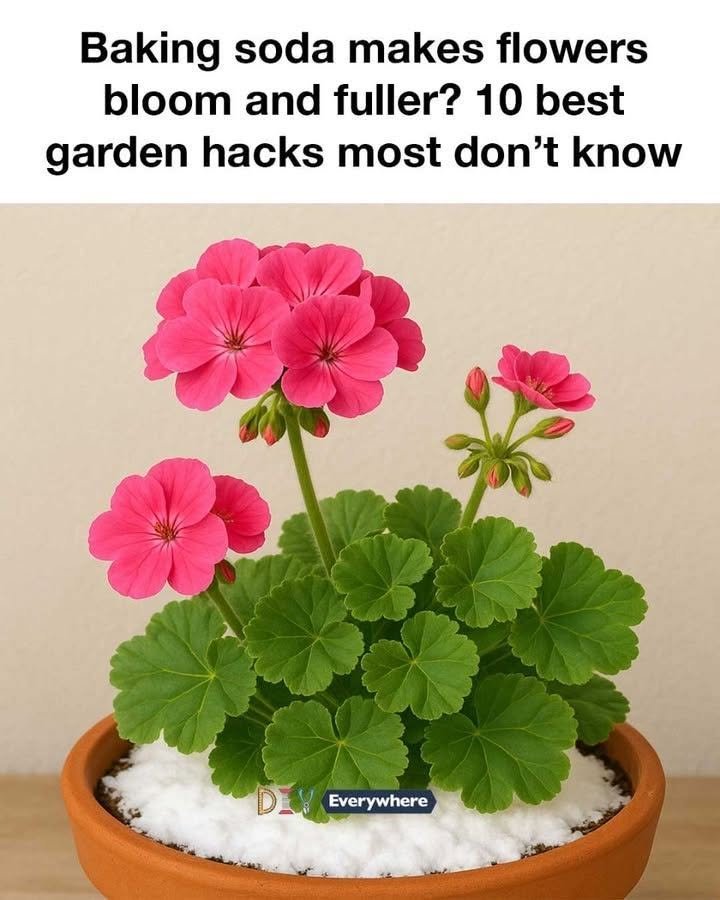
Let’s dive into the fascinating world of garden hacks, starting with specific question about baking soda, and then moving on to other lesser-known, effective tricks.
The Truth About Baking Soda in the Garden
You’ll see this hack all over the internet, but its effectiveness is highly conditional, and it’s not the “bloom booster” it’s often claimed to be.
Does it make flowers bloom and fuller?
No, not directly. Baking soda is sodium bicarbonate and contains no phosphorus or potassium, the key nutrients that drive flower production. If your soil is very acidic and your plants (like clematis, dianthus, or lavender) prefer alkaline conditions, a mild, diluted baking soda solution can slightly neutralize the soil pH, making existing nutrients more available. This indirect effect might make a plant look a bit happier, but it’s not a fertilizer.
Where it IS a useful hack (with a big caution):
It acts as a mild fungicide. A solution of 1 teaspoon of baking soda in a quart of water, with a few drops of liquid soap to help it stick, can be sprayed on susceptible plants (like roses, lilacs, and squash) to prevent and slow powdery mildew. This creates an alkaline environment on the leaf surface that fungal spores don’t like.
Crucial Caution: Baking soda is a salt. Overuse will build up in the soil, burn leaves and roots, and kill your plants. Use it only as a targeted foliar spray for fungal issues, never as a general soil drench.
Now, here are 10 Best Garden Hacks Most Don’t Know, built on sound gardening principles.
1. The Pot-in-a-Pot Trick for a Dynamic Garden
Tired of digging up and rearranging plants every season? Bury an empty plastic nursery pot in the ground, leaving the rim just above the soil line. Then, slip a matching-sized potted plant into it.
-
Why it’s brilliant: You can instantly swap out a spent spring annual for a summer-blooming plant in 10 seconds. It’s perfect for keeping your garden looking fresh and for creating a seamless “planted” look for container plants that need winter protection.
2. Cinnamon: The All-Purpose Healing Dust
This isn’t just for baking. Ground cinnamon has powerful antifungal and antibacterial properties.
-
How to use it: After taking stem cuttings, dip the wounded end in cinnamon before putting it in soil. It acts as a rooting hormone and prevents damping-off disease. If you have a small wound on a plant stem from pruning, dust it with cinnamon to seal and sterilize the cut. It’s also a safe, gentle way to discourage mold on the soil surface of seedlings.
3. The Perfect Planting Hole with a Dollar Store Laundry Basket
For plants that hate having their roots disturbed (like baptisia, peonies, and poppies), the “forever home” planting hole is key. Dig your hole, place a cheap plastic laundry basket inside, and fill it with your best soil and plant.
-
Why it’s brilliant: The basket prevents aggressive surrounding roots (like from trees or shrubs) from invading the root ball of your new plant for years, while allowing the plant’s roots and water to move freely. When you dig it up 5 years later to divide it, the root ball comes out cleanly.
4. Lazy Composting: Dig and Drop (Trench Composting)
Forget the turning, the ratios, the pile. This is composting without the work.
-
How to do it: Any time you have a bowl of vegetable scraps, coffee grounds, and eggshells, go into a garden bed, dig a hole about 12 inches deep with a post-hole digger or trowel, dump the scraps in, and cover with soil.
-
Why it’s brilliant: It directly feeds the soil food web and earthworms right where the plants need it. There’s no smell, no animals will dig it up if buried deep enough, and it’s the ultimate act of keeping your kitchen waste in your own ecosystem.
5. Milk and Water Spray for a Mid-Summer Lifesaver
Powdery mildew is the bane of late summer gardens (zucchini, phlox, bee balm). Cow’s milk is a surprisingly effective preventative.
-
The Science: When milk proteins and fats are exposed to sunlight, they form an antiseptic layer that kills fungal mycelia.
-
The Recipe: Mix a 40% milk (any fat content) to 60% water solution in a spray bottle. Spray susceptible plants thoroughly every 7-10 days, starting before you see the mildew. It’s not a cure for a heavy infestation, but a fantastic preventative.
6. The Cardboard and Mulch Smother (No-Dig Bed)
Kill your grass and create a new garden bed without a drop of herbicide or back-breaking labor.
-
How to do it: In fall, lay down a single layer of plain, uncoated cardboard (tape removed) directly over the lawn you want gone, overlapping the edges by 6 inches. Wet the cardboard thoroughly until it’s soggy. Cover with 4-6 inches of wood chips or leaf mold.
-
Why it’s brilliant: By spring, the grass will be dead and decomposed by worms and microbes, leaving you with a weed-free, moisture-retentive, plantable bed. The cardboard blocks light, and the mulch holds it all together.
7. The Ultimate Slug and Snail Defense: A Copper Penny Barrier
Slugs and snails generate a tiny electrical charge when their slime touches copper, giving them a mild but highly effective shock. They will turn back.
-
How to use it: Glue pennies (pre-1982 are pure copper, but modern ones work too) around the rim of a favorite pot. Better yet, buy copper tape—it’s cheap and widely available. Wrap a wide band of it around the outside of pots or raised bed legs. It’s a 100% non-toxic, permanent barrier. Vaseline smeared on the outside of the tape makes it impassable.
8. The Diaper Hack for Hanging Baskets
Hanging baskets dry out terribly fast. The solution is from the baby aisle.
-
How to do it: Before filling your hanging basket with potting mix, lay a clean, super-absorbent diaper in the bottom with the absorbent side facing up. Cover it with a little soil and plant as usual.
-
Why it’s brilliant: The crystals in the diaper will absorb and hold huge amounts of water, releasing it slowly back to the roots and dramatically extending the time between waterings. This works with the same principle as expensive polymer water crystals, at a fraction of the cost.
9. Epsom Salt: The Targeted Bloom Tonic
Unlike baking soda, this hack is based on solid plant science for specific plants. Epsom salt is magnesium sulfate. Magnesium is the central atom in the chlorophyll molecule and is critical for plants to absorb phosphorus, the main bloom-boosting nutrient.
-
When to use it: Not for everything. It’s magic for heavy feeders that show their magnesium deficiency through yellowing between leaf veins: roses, tomatoes, and peppers.
-
The Recipe: At the time of planting and again when flowers first appear, work 1 tablespoon of Epsom salt into the soil around the plant’s base, or dissolve 1 tablespoon in a gallon of water for a soil drench.
10. Weed Killer Where You Want Nothing to Grow
For a completely natural, short-term total vegetation killer in paths, patios, or driveways, this is far more effective than vinegar alone.
-
The Potent Recipe: 1 gallon of horticultural vinegar (20-30% acetic acid is far stronger than kitchen vinegar), 1 cup of table salt, and 1 tablespoon of liquid dish soap.
-
Why it works: The acetic acid burns the foliage, the soap breaks the surface tension so it sticks, and the salt is absorbed by the roots, disrupting the plant’s ability to take up water.
-
Massive Caution: This is non-selective. It will kill everything it touches, and the salt can build up in the soil. Use it only where you want nothing to grow for a long time, like between pavers. Keep it well away from your garden beds.
I hope these bring you a season of incredible growth and beauty. Happy gardening