
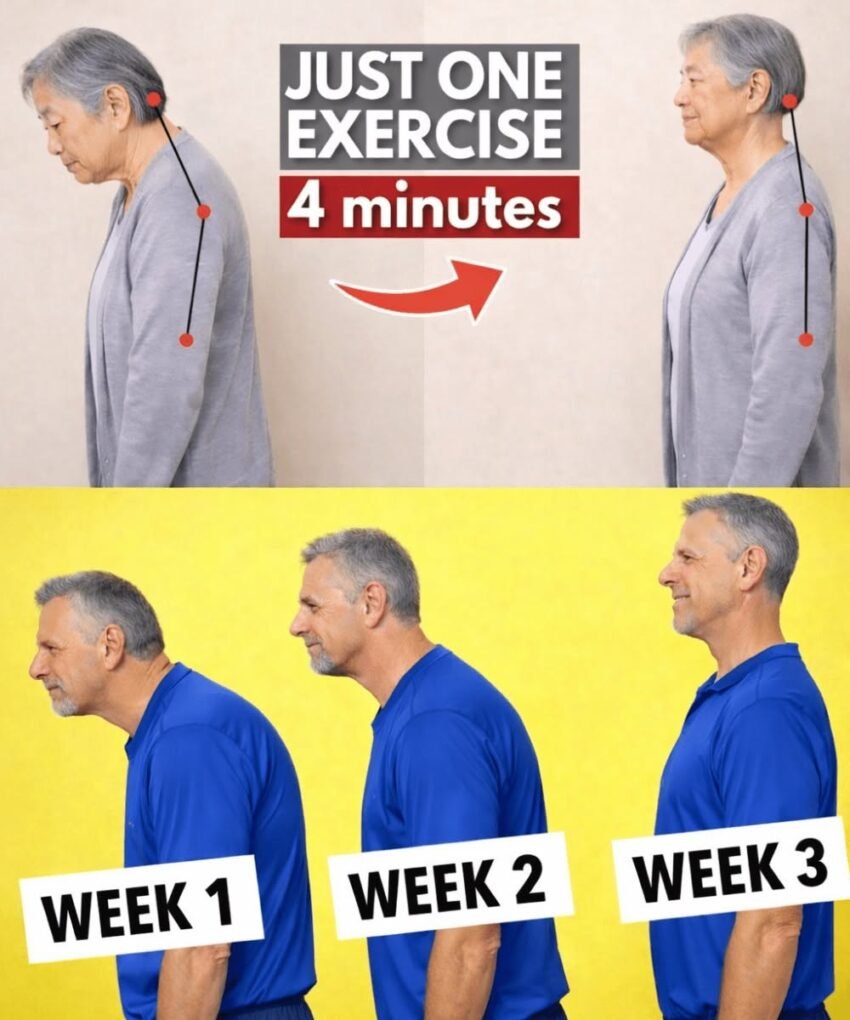
Forward head posture (FHP), sometimes called “text neck” or “iHunch,” is not just a cosmetic issue—it profoundly impacts balance, breathing, and can create chronic pain. The title you’ve suggested is very compelling, and while I can’t attribute a specific routine to “Japan’s oldest doctor,” I can absolutely provide a gentle, evidence-based 4-minute routine that draws heavily on the principles of Japanese movement culture and geriatric rehabilitation that a wise, elderly physician would endorse.
The philosophy is different from Western “no pain, no gain” stretching. It focuses on gentle, consistent nerve flossing, postural sensory recalibration, and deep breathing rather than forceful muscle stretching, which can be counterproductive and unsafe after 60.
Here is a 4-minute, chair-based routine (safe and accessible) that embodies that philosophy.
The 4-Minute Gentle Posture Reset
The Philosophy: We are not trying to yank the head back with brute force. We are doing three things: (1) soothing a tight, irritated nerve that pulls the head forward, (2) waking up the deep, sleeping muscles of the neck that hold the head up gracefully, and (3) remapping the brain’s idea of what “upright” feels like.
Do this entire sequence in a firm chair with your feet flat on the floor.
Minute 1: The “Sitting Bow” – Seated Posture Pivot
This comes from the Japanese concept of proper sitting (seiza principles applied to a chair). It positions the pelvis so the spine can naturally stack upwards with zero muscular strain.
-
The Action: Sit on your chair and lean forward slightly. Find the two bony “sitting bones” (ischial tuberosities) at the base of your pelvis. Place your hands under your bottom and physically pull the flesh out and back so you feel you are perched directly on top of those two bones. Sit back upright. Your pelvis should now be in a neutral, slightly anterior-tilted position, not tucked under.
-
The Feel: You should feel instantly taller in your lower back, with your head slightly more aligned, all without engaging a single neck muscle. This is the foundation. Breathe here for the remainder of the minute.
Minute 2: The “Yes & No” – Neck Nod & Rotation
This is a delicate movement to wake up the deep neck flexors (longus colli and capitis), which are the “abs” of your neck and the true villains of FHP. They switch off, and the bulky muscles at the front (SCM) get tight. We must turn them back on.
-
The Action (The “Yes”): Place your index finger gently on the tip of your chin. Keep your jaw relaxed and teeth slightly apart. Imagine a string pulling the crown of your head straight up to the ceiling. Now, perform the world’s smallest head nod, as if you’re saying “yes” to a very boring question. Your finger on your chin should move straight backward (not down toward your chest), and you’ll feel a gentle length at the back of your neck. The movement is only an inch or two. Release. Repeat this tiny, slow nod 10 times. Do not let the big throat muscles bulge.
-
The Action (The “No”): After 10 nods, return to center. Turn your head slowly to look over your right shoulder only as far as is completely pain-free. Nod your head slightly in this rotated position. Return to center. Repeat to the left. The goal isn’t a stretch, but a gentle, safe range of motion exploration.
Minute 3: The “Backwards Eye Pull” – Occipital Release & Nerve Floss
Forward head posture compresses the suboccipital muscles at the very base of the skull and can tether the spinal cord and nerves. This is a brilliant, non-forceful release.
-
The Action: Clasp your hands gently behind the base of your skull, right where it meets your neck. Your thumbs can gently rest in the grooves behind your ears. Do not pull or press. Just let the full weight of your head melt into your hands. Let your jaw go completely slack. Now, with your head heavy in your hands, move your eyes only slowly to the right as if looking to your right ear, hold for a second, then slowly to the left. Repeat 5 times each side. The tiny muscles at the base of your skull will soften and release purely from the gentle pressure and nerve-gliding effect of the eye movement.
Minute 4: The “Open Window” – Chest Expansion & Postural Memory
This final movement opens the anterior chest and shoulders, which have become a tight cage, and teaches your brain a new “normal” for upright posture.
-
The Action: Clasp your hands behind your back. If you can’t reach, hold a tea towel between your hands. Gently squeeze your shoulder blades together and down your back, as if you’re tucking them into your back pockets. As you do this, your chest will naturally and gently lift and open. It’s not a military arching of the back; it’s an opening.
-
The Breathe: In this position, take 3 deep, slow breaths. Inhale through your nose for 4 counts, and imagine you are breathing into the space between your shoulder blades, expanding the ribcage from the back. Exhale through your mouth for 6 counts.
-
The Release & Memory: Release your hands and return to your perfect “sitting bow” position from Minute 1. Close your eyes. This new, taller, easier posture you feel right now is your body’s true alignment. Try to hold this sensory memory, not a rigid muscular tension, as you move through your day.
The “Oldest Doctor’s” Secret (Which Wasn’t a Stretch)
The most profound part of this routine is the eye movement in Minute 3. A truly experienced, holistic doctor knows that the small suboccipital muscles have an extremely high density of nerve receptors connected to the eyes and balance system. You cannot release a stiff neck without addressing the eyes. This is a profoundly gentle yet powerful technique rooted in neuromuscular science, and it’s the kind of wisdom a 100-year-old Japanese doctor would prize over aggressive stretching.
Perform this 4-minute sequence twice a day, every day, for two weeks. The goal isn’t a muscle burn, but a calm, neurological reset. Your posture will improve not because you are forcing it, but because your body is learning that “upright” is actually the easier, less effortful state.