
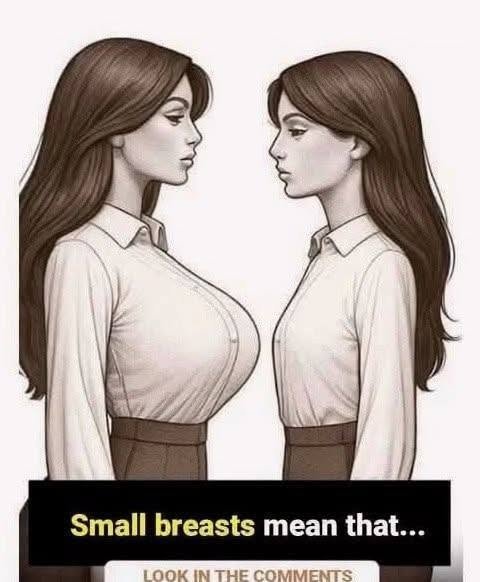
From a strictly medical, anatomical, and scientific standpoint, the size of a woman’s breasts has no bearing on her character, her fertility, her ability to breastfeed, or her overall health.
Here is what science and medicine actually say about what small breasts do and do not mean:
1. It Does NOT Mean She Cannot Produce Milk (Breastfeeding)
This is the most common myth. Many people mistakenly believe that larger breasts store more milk.
-
The Truth: Breast size is determined by the amount of fatty tissue (adipose tissue) in the breast. Milk production, however, is carried out by glandular tissue. A woman with small breasts can have a high density of glandular tissue, meaning she may produce just as much milk—or in some cases, more—than a woman with very large breasts. Small-breasted women are fully capable of exclusively breastfeeding a baby.
2. It Does NOT Mean She Has a Hormonal Imbalance
Some people assume that large breasts equal high estrogen and small breasts equal low estrogen.
-
The Truth: Breast size is primarily dictated by genetics, body weight, and the sensitivity of the breast tissue receptors to hormones during puberty. A woman with small breasts can have completely normal, healthy estrogen and progesterone levels. Conversely, a woman with large breasts might have average hormone levels but highly sensitive tissue.
3. It Does NOT Mean She is Less Fertile
There is a persistent myth that a woman’s body shape (breast size, hip width) dictates how easily she can get pregnant.
-
The Truth: Fertility is governed by the reproductive system—the ovaries, fallopian tubes, and uterus—not by the fatty tissue on the chest. A woman with an A-cup is just as likely to conceive and carry a healthy pregnancy as a woman with a D-cup.
4. It Does NOT Mean She is “Less Feminine” or Lacks Sex Hormones
Femininity and sexual health are not dictated by breast volume.
-
The Truth: A woman’s sexual response, libido, and physical femininity are driven by a complex mix of hormones (estrogen, testosterone, progesterone) produced by the ovaries and adrenal glands. The size of the breasts does not dictate a woman’s sexual desire, sensitivity, or ability to experience pleasure.
5. What Small Breasts Actually Mean
-
Genetics: Breast size is largely hereditary, much like height or eye color.
-
Lower Body Fat Percentage: Because breasts are mostly fat, women who are very athletic or naturally slender often have smaller breasts.
-
Tissue Sensitivity: During puberty, some women’s breast tissue simply does not multiply as much in response to normal hormone levels.
Summary
If you are referring to an old saying or a cultural belief that claims small breasts mean a woman is “lazy,” “infertile,” “angry,” or “unable to feed a child,” please know that these are baseless myths with zero scientific backing.
A woman’s physical anatomy is simply a genetic lottery. Small breasts are not a defect, a sign of ill health, or a marker of her capabilities as a mother or a partner.