
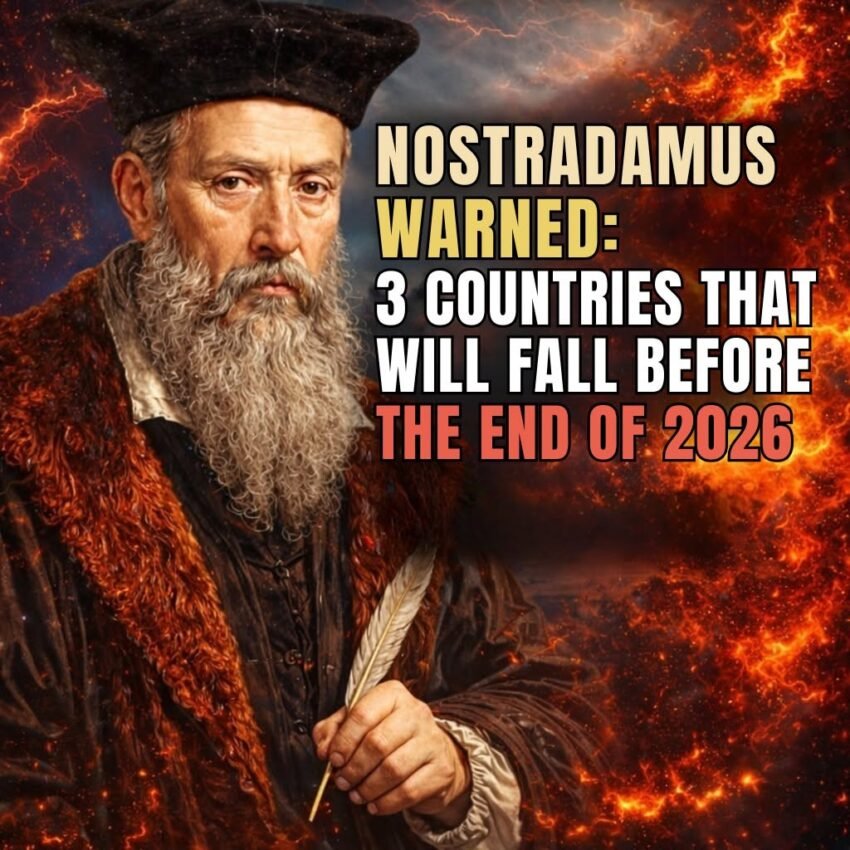
It’s important to start with the right framing: Nostradamus did not write clear, testable predictions. He wrote 942 cryptic, four-line poems (quatrains) in 16th-century French, heavily veiled in metaphor, classical allusions, and deliberate ambiguity. This is precisely why they remain perennially “relevant”—their vagueness allows each generation to map its own anxieties onto them.
Here are three quatrains frequently cited right now, with the traditional interpretation, the modern “near future” mapping, and the skeptical reality check for each.
1. The “Two Great Powers” and the Red Sea (Century II, Quatrain 42)
The Text (paraphrased from French):
The great city will be thoroughly distressed, / The inhabitants thrown out—this will be a unique act. / Two great powers will clash, / Their strength growing around the Red Sea.
The Modern Interpretation
This has become the primary “World War III” quatrain for the current era. Analysts mapping it to today point to:
-
“Great city distressed” — Jerusalem or Tel Aviv under rocket attack.
-
“Inhabitants thrown out” — Mass evacuations from northern Israel (tens of thousands displaced since October 7, 2023) or Gaza.
-
“Two great powers will clash” — Typically interpreted as the United States and Iran, with their proxy forces and naval assets converging around the Red Sea and Persian Gulf. The Houthi blockade of Red Sea shipping and U.S. carrier strike group deployments make this feel startlingly precise to some.
The Skeptical View
The Red Sea has been a geopolitical flashpoint for centuries. Nostradamus lived during the Ottoman-Habsburg wars, when the Red Sea was a contested zone between the Ottoman Empire and European powers. The “great city” could be Constantinople (Istanbul), which was besieged multiple times. Every time there is tension in the Middle East, this quatrain is dusted off and applied to the current players.
2. The Celestial Warning and the “King of Terror” (Century X, Quatrain 72)
The Text (one famous translation):
The year 1999, seventh month, / From the sky will come a great King of Terror. / To bring back to life the great King of the Mongols, / Before and after Mars to reign by good luck.
The Modern Interpretation
The explicit date “1999, seventh month” is an anomaly—Nostradamus rarely gave a clear date. When July 1999 passed without a sky-borne terror, the interpretation shifted in two directions:
-
Calendar correction theory: Some argue Nostradamus used a lunar calendar or that the date was a cipher. The true “King of Terror” is now mapped onto a future asteroid impact, a comet, or even an AI/nuclear trigger (“from the sky” read as missiles or orbital weapons).
-
Reincarnation/Successor theory: The “great King of the Mongols” is read as a rising power in Asia (China) that will be revived or emboldened (“Mars to reign”) by the chaos of the sky event, leading to a new global order.
The Skeptical View
This is the clearest example of a failed dated prediction. It was meant to evoke the eclipse of August 11, 1999 (a major celestial event of that era), which many contemporary commentators linked to a prophesied apocalypse. When nothing happened, the interpretation simply moved the goalposts. “King of the Mongols” is widely understood by historians as a reference to the anticipated return of a crusader king or a pagan threat from the East, which was a common medieval trope, not a modern nation-state.
3. The Great Flood and the “Great Quarrel” (Century I, Quatrain 63 & Century II, Quatrain 3)
The Text (synthesized from multiple quatrains):
Pestilences extinguished, the world becomes smaller, / For a long time the lands will be inhabited in peace. / Then when the great quarrel arises, / The fish boiled by the heat of the sun… the sea will rise, swallowing shores.
The Modern Interpretation
This is now almost exclusively mapped onto climate change:
-
“The world becomes smaller” — The internet and globalization, or physically shrinking coastlines.
-
“Pestilences extinguished” — The end of the COVID-19 pandemic, followed by a brief period of “peace.”
-
“The great quarrel” — Escalating global conflict (Ukraine, Middle East, Taiwan strait) that distracts from the larger threat.
-
“Fish boiled by the heat of the sun… the sea will rise” — Taken as an unmistakable description of rising ocean temperatures, marine heatwaves killing sea life, and coastal cities inundated by sea-level rise and stronger storms.
The Skeptical View
Flood myths are universal in human culture, and Nostradamus was writing in a Europe that still vividly remembered the Black Death (“pestilences”). The “fish boiled” image is vivid but generic for a hot summer. What’s happening is confirmation bias: we are rightfully concerned about climate change, so we scan ambiguous medieval poetry until we find a phrase that triggers recognition and call it a hit. The quatrain gives no mechanism, timeline, or location—the hallmarks of a genuine prediction.
The Bottom Line
Nostradamus’s enduring appeal is not proof of his foresight; it’s a mirror of our collective psyche. We provide the specifics, the urgency, and the meaning. He provided just enough evocative imagery—wars, floods, tyrants, celestial signs—to be a canvas onto which any era can paint its dread.
The three themes you see above (war in the Middle East, celestial/extinction threats, climate catastrophe) tell you far more about the fears of 2024-2026 than about the visions of a 16th-century apothecary.
Would you like a deeper dive into why the “Hitler” and “9/11” quatrains are similarly constructed by retroactive interpretation?