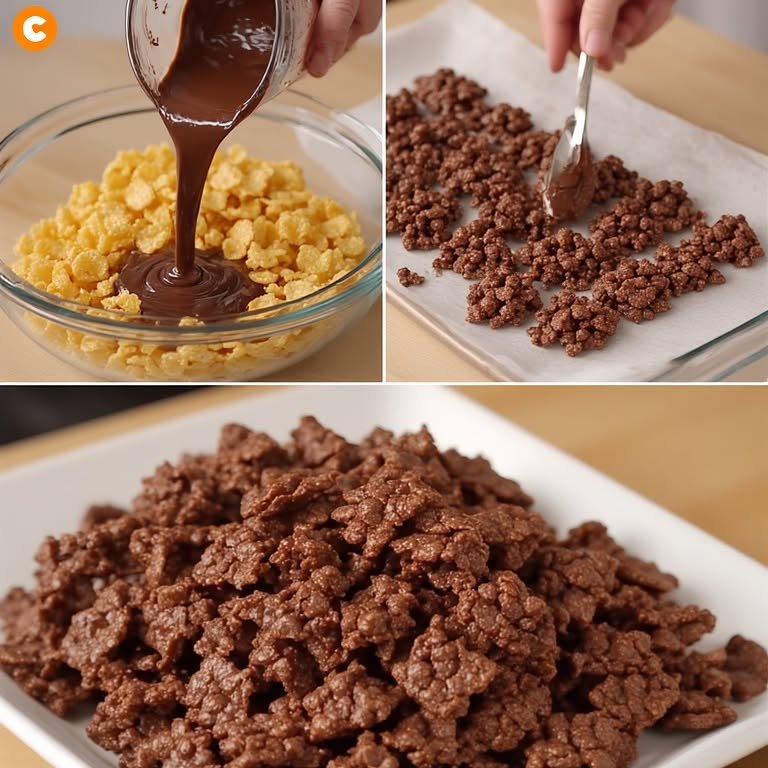
This is a classic French no-bake confection, and the name is pure poetry: “Desert Roses” or “Sand Roses.” They’re named after the delicate, flower-like crystal formations found in deserts, and the chocolaty, cornflake clusters do indeed resemble those sandy, petaled stones.
What Are Roses des Sables?
At their heart, they are simple: cornflakes coated in melted chocolate and/or tempered fat, spooned into little craggy mounds, and left to set. The cornflakes give the “sandy,” crystalline crunch, and the ruffled, irregular clusters look uncannily like desert rose mineral formations.
They are the French cousin of the American chocolate haystack or the British chocolate cornflake cake, but with a particular emphasis on a glossy, almost matte, crystalline finish that comes from using a specific fat: vegetaline (a brand of hydrogenated coconut oil) or, more accessibly, refined coconut oil.
Nana’s French Kitchen (or Maybe Your Kitchen’s French Heart)
Imagine a different kitchen now, perhaps in France, perhaps in your own home where a well-worn French cookbook lives. The air doesn’t smell of yeast and caramelizing sugar this time, but of melting chocolate, warm and deep.
The pan is a bain-marie—a bowl set over barely simmering water. A child’s job is to watch, stirring very, very slowly, as dark chocolate melts into a pool of silk. A knob of white coconut fat dissolves invisibly, its only trace a promise of the crisp “snap” to come.
Then the cornflakes. Golden, sturdy, unsweetened. They’re tipped into the velvet chocolate and folded in with infinite care. The goal: coat every single flake without crushing a single one. Nana’s hands might have been gentle, but the sound was a crackling whisper, like walking on dry sand.
The spoon drops craggy little nests onto parchment paper. They are not shaped, they happen—each one a unique, edible desert rose. A tray is slid into a cool pantry (or the refrigerator, in modern times) and the hardest part begins: waiting.
Classic Recette: Roses des Sables
If you’d like to recreate them, this is the authentic French method, with the key ingredient that makes them authentically “rosy” and not just chocolate cornflake clusters.
Yield: About 20-25 roses
Set Time: 1 hour
Ingredients
-
200 g (7 oz) dark chocolate (52-70% cacao), finely chopped. (In France, chocolat à pâtisser like Nestlé Dessert or Cacao Barry.)
-
50 g (3 ½ tablespoons) refined coconut oil (or vegetaline). This is the secret. It helps the chocolate set with a matte, lacy, crystalline finish that mimics the desert rose mineral, and it gives a sharp, brittle snap at room temperature. Do not use unrefined coconut oil unless you want a coconut flavor.
-
100 g (about 4-5 cups) unsweetened cornflakes (the classic yellow box, not frosted or honey-nut).
-
(Optional, but authentic variations) A handful of slivered almonds or crushed hazelnuts; a pinch of fleur de sel.
Instructions
-
Melt the Chocolate: Place the chopped chocolate and coconut oil in a heatproof bowl over a pot of barely simmering water (bain-marie). The bowl must not touch the water. Melt slowly, stirring with a spatula, until perfectly smooth and glossy. Remove from heat as soon as it’s melted; overheating is the enemy of shine.
-
The Gentle Fold: Pour the cornflakes into the bowl of melted chocolate. With the spatula, fold gently from the bottom up, turning the mixture over and over, scooping and coating, until every cornflake is no longer pale gold but a rich, dark brown. This takes patience. Move slowly to keep the flakes whole.
-
Shape the Roses: Line two baking sheets with parchment paper. Using a tablespoon or a soup spoon, scoop small mounds of the mixture and drop them onto the paper. Don’t press or compact them—let them be airy, craggy, irregular. Use the tip of the spoon to nudge any stray flakes into the cluster. Their beauty is in their imperfection.
-
Set and Harden: Leave the trays at cool room temperature for the most authentic, matte, crystalline finish. (A cool pantry, cellar, or just the coolest spot in the kitchen.) They will set in about 1-2 hours. If your kitchen is warm, place them in the refrigerator for 30 minutes, but know the finish will be a little less “sandy” and a little more shiny.
-
Store: Once set, store them in an airtight tin in a cool place, with parchment paper between layers. They keep for a week but are at their crunchiest and most beautiful on the day they’re made.
The French Grandmother’s Variations
Just as your Nana had her Sugar Snail secrets, a French mémé or mamie would have her own petits secrets for Roses des Sables:
-
Rice Krispies/Coco Pops: Some used a mix of cornflakes and Rice Krispies for a lighter, airier crunch.
-
The Almond Addition: In Provence, a few slivers of toasted almonds were mixed in, adding a note of the garrigue—the rocky, herb-scented landscape—to the chocolate.
-
Coffee Essence: A single teaspoon of very strong liquid coffee or coffee extract added to the melted chocolate made them Roses des Sables au Café, a sophisticated adult version.
-
The Christmas Version: Topped with a single silver dragée (a sugar-coated almond pearl) pressed into the top before setting, making them festive and jewel-like.
Two Nanas, Two Kitchens, One Kind of Love
It strikes me that whether it’s Nana’s yeasty, sugar-crusted Snails baking in an American oven, or a French Grand-mère carefully folding cornflakes into dark chocolate, the gesture is identical:
A small, sweet, handmade thing, created not for show but for the pure, simple joy of giving it to someone you love. Both recipes are humble in their ingredients—flour, sugar, cornflakes, chocolate—but they become priceless because of the hands that made them.
Do you have a memory of Roses des Sables? Were they made in your family, or is this a new recipe that caught your eye and captured your heart?