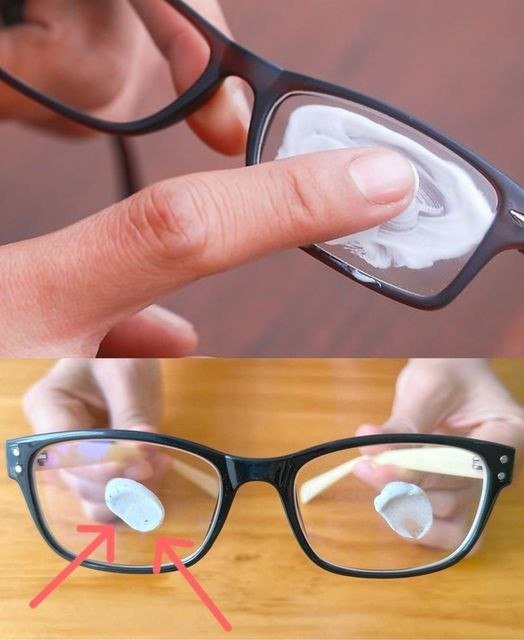
This is another very popular “life hack” that circulates widely online. However, before you put toothpaste on your prescription glasses or expensive sunglasses, it’s important to understand what actually happens — because in most cases, this trick will permanently ruin your lenses.
Here is the honest, evidence-based breakdown of the toothpaste method for removing scratches from glasses.
The Short Answer (Most Important)
Do not use toothpaste on glasses lenses — especially if they have anti-reflective (AR), anti-scratch, or blue-blocking coatings.
Toothpaste does not remove scratches. It etches or wears away the lens coating, which can temporarily make the scratch less visible by removing the coating around it. In reality, you are trading a small scratch for a larger, cloudy, distorted area.
What Toothpaste Actually Does to Lenses
| Your expectation | What really happens |
|---|---|
| Scratch disappears | Scratch remains; surrounding coating is abraded away |
| Lenses become clear | Lenses become foggy, hazy, or covered in micro-scratches |
| Save money | Lenses ruined — must buy new ones |
How it works (the chemistry):
-
Toothpaste contains abrasives (silica, baking soda, calcium carbonate, or hydrated alumina).
-
These abrasives are harder than the anti-reflective coating and softer plastic lenses (CR-39, polycarbonate, Trivex).
-
Rubbing toothpaste on lenses physically removes the coating in a non-uniform way, creating a permanent “smear” of damage.
Glass lenses (very rare today): Toothpaste might polish glass slightly, but almost all modern glasses are plastic or polycarbonate. Even glass lenses have coatings that will be destroyed.
Why This Myth Persists
-
Confirmation bias – People with uncoated plastic lenses might see a very slight temporary improvement because toothpaste fills micro-scratches with glycerin or sorbitol (humectants). This effect lasts only until the lenses are cleaned again.
-
Old trick for CDs/DVDs – Toothpaste could sometimes polish polycarbonate discs (no coatings). Glasses are not the same.
-
Misunderstood “polishing” – Real optical polishing requires graded cerium oxide and specialized equipment. Toothpaste is not a substitute.
What Happens to Different Lens Types
| Lens type | Effect of toothpaste |
|---|---|
| Uncoated plastic (CR-39) | Creates hazy micro-scratches; scratch remains visible |
| Polycarbonate | Soft surface; becomes cloudy and distorted |
| Anti-reflective coated | Coating is removed in patches — lenses become unusable |
| Glass (old, uncoated) | May slightly polish, but glass is hard to scratch; toothpaste is too mild to remove deep scratches |
| Transition/photochromic | Destroys the tinted coating layer |
The One Exception (Not for Vision Glasses)
Toothpaste can be used to polish very minor surface scuffs on:
-
Cheap costume sunglasses (no coatings)
-
Safety glasses (uncoated polycarbonate)
-
Dive mask lenses (uncoated tempered glass)
Even then, results are poor and inconsistent.
What Actually Works to Remove or Hide Scratches
Truth: You cannot “remove” scratches from coated plastic lenses. Period.
Your only real options:
-
Live with small scratches – If they don’t affect vision, ignore them.
-
Fill scratches (temporary) – Apply a tiny amount of petroleum jelly or carnauba wax to the scratch. This fills it optically and makes it less visible until wiped off. (Not a fix, but harmless.)
-
Replace the lenses – Most optical shops can replace just the lenses (keep your frames) for $50–150. Cheaper than new glasses.
-
Use your warranty – Many anti-scratch coatings come with a 1–2 year warranty.
What Not to Try (Worse than toothpaste)
-
Baking soda paste
-
Vinegar
-
Magic eraser (melamine foam)
-
Nail buffer blocks
-
Car scratch remover
All of these will destroy coatings faster than toothpaste.
Preventing Future Scratches
-
Clean lenses only with – Microfiber cloth + lens spray or mild dish soap + water.
-
Never wipe dry – Dust + dry wiping = sandpaper effect.
-
Store in a hard case – Not loose in pocket or bag.
-
Avoid paper towels, tissues, or clothing – These contain wood fibers or silica that scratch.
Final Verdict
| Claim | Reality |
|---|---|
| “Apply a little toothpaste and scratches disappear instantly” | False. You will permanently damage your lenses. |
| “Don’t waste money” | Actually, you will waste more money replacing ruined lenses. |
| “Works for all glasses” | Dangerously false. Only maybe for old glass lenses without coatings. |
Bottom line: If scratches bother you, visit an optician. A $50–100 lens replacement is far cheaper than buying new frames — and much smarter than destroying your current lenses with toothpaste.
Would you like tips on how to find affordable lens replacement services online or locally?