
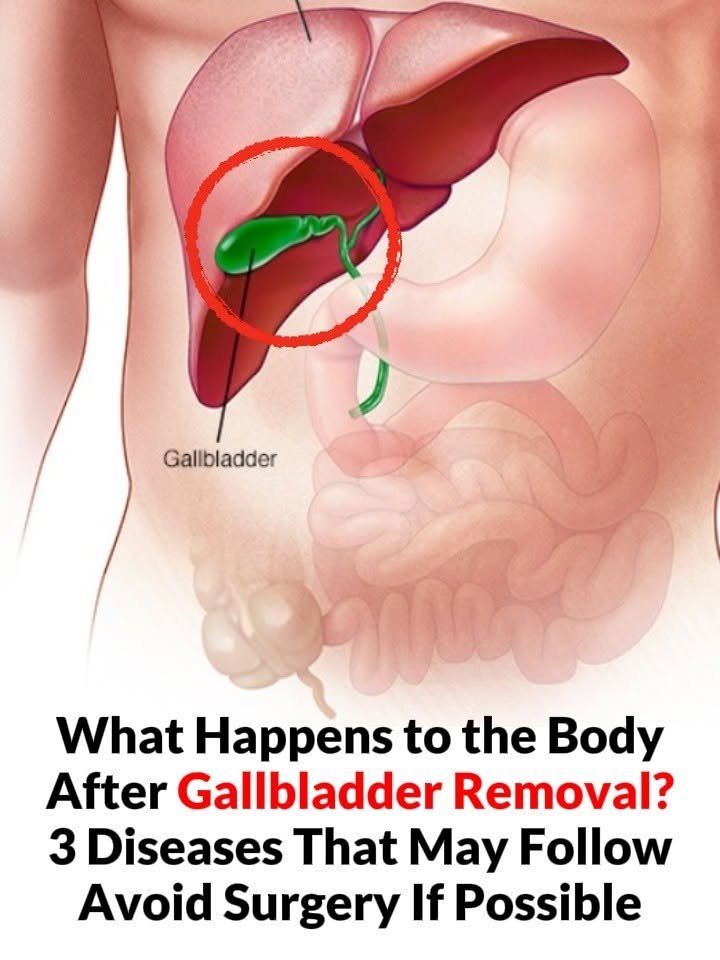
The gallbladder is often portrayed as a “non-essential” organ you can live without—and technically, you can. However, the narrative that it has no function is a dangerous oversimplification. The gallbladder isn’t just a storage bag; it’s a timing-and-concentration device for your digestive system.
When it’s removed (cholecystectomy), your body doesn’t just go back to normal minus a bag. It fundamentally changes the physics of digestion, and for a significant minority of patients, this leads to chronic, life-altering conditions.
Here’s what happens to your body and the three overlooked diseases that can follow.
The Immediate Physiological Change: The Drip, Not the Dump
First, understand what the gallbladder does. Your liver constantly produces bile, a greenish-yellow fluid that acts like detergent to break down fats. The gallbladder concentrates this bile 5-10 times and stores it. When you eat a fatty meal, a hormone (CCK) triggers the gallbladder to squeeze a concentrated “slug” of bile into the small intestine right at the perfect moment.
Without a gallbladder:
-
The Drip Effect: Bile now trickles continuously from the liver directly into your small intestine, 24/7, like a leaky faucet.
-
Diluted Power: This constant bile is weak and unconcentrated, so it’s less efficient at breaking down large fat globules.
-
The Timing is Off: There’s no bolus release synchronized with a meal. You have bile when you don’t need it (causing irritation) and not enough concentrated power when you eat a burger.
This single change sets the stage for the “post-cholecystectomy syndromes.”
3 Diseases That May Follow Removal
If the body cannot adapt to this new “constant drip” physiology, one or more of the following conditions often develops:
1. Post-Cholecystectomy Diarrhea (Bile Acid Malabsorption)
This is the most common, yet most under-diagnosed, consequence. It affects up to 20% of patients, though many are never told this could happen.
-
What Happens: The continuous trickle of bile acids reaches the colon. Bile acids are caustic; they chemically irritate the colon lining and draw in massive amounts of water, just like a laxative.
-
The Symptom: Sudden, urgent, watery diarrhea. It’s often yellow, greasy, and physically burns. The urgency can be severe (the “gotta go right now” feeling) because the bile acids trigger colonic contractions.
-
The Misdiagnosis: It is frequently mislabeled as irritable bowel syndrome with diarrhea (IBS-D). If you’ve had your gallbladder out and struggle with urgent diarrhea, especially after eating, you don’t have IBS—you likely have bile acid malabsorption.
2. Non-Alcoholic Fatty Liver Disease (NAFLD) Acceleration
This is a silent, long-term metabolic earthquake. Gallbladder removal is now considered an independent risk factor for developing a fatty liver.
-
What Happens: Bile is a critical signaling molecule, not just a detergent. It turns on receptors (FXR and TGR5) that regulate your entire metabolism, including how your liver handles glucose and fat.
-
The Mechanism:
-
The constant trickle of bile disrupts these receptors, leading to increased fat creation (lipogenesis) in the liver.
-
Bile acids also regulate your gut bacteria. The continuous drip alters the microbiome, favoring bacteria that extract more calories from food and produce inflammatory compounds that are sent directly to the liver via the portal vein.
-
-
The Result: The liver gets “painted” in fat. Studies show that individuals without a gallbladder have a significantly higher prevalence of NAFLD, independent of weight and other risk factors.
3. Sphincter of Oddi Dysfunction (SOD)
This is the rarest but most painful of the trio. The Sphincter of Oddi is a muscular valve where the bile and pancreatic ducts meet and empty into the small intestine.
-
What Happens: In a healthy body, the gallbladder and this sphincter work in sync. When the gallbladder squeezes, the sphincter relaxes. Remove the gallbladder, and the wiring can short-circuit. The sphincter can become hypertonic (tight) or spasm.
-
The Symptom: This creates a functional blockage. Bile and pancreatic juices back up, causing severe, debilitating pain in the upper right abdomen, identical to the gallbladder attacks that led to surgery in the first place.
-
The Tragedy: Patients often undergo removal for this exact pain, only to have the pain return weeks or months later because the sphincter is now the problem. It’s a challenging diagnosis to treat, as cutting the sphincter surgically carries a high risk of severe pancreatitis.
“Avoid Surgery If Possible”: The Non-Surgical Lifelines
The statement “avoid surgery if possible” isn’t about refusing a necessary, life-saving procedure for a gangrenous or perforated gallbladder. It’s about treating a functional or symptomatic gallbladder before it reaches the point of no return. Surgery for biliary dyskinesia (a sluggish gallbladder with no stones) has a lower success rate than for stones, precisely because the underlying disorder is often a metabolic, whole-body issue.
If you have stones or sludge but no emergency, consider these medical strategies first:
-
Ursodeoxycholic Acid (UDCA): This is a pill-form bile acid that can literally dissolve small cholesterol stones over 6-18 months. It changes the composition of your bile from sludge-forming to fluid. It works best for small stones (<1.5cm) in a functioning gallbladder.
-
Reduce Bile Supersaturation: Stones form when your bile is too concentrated with cholesterol. A diet low in refined sugar and high in soluble fiber (psyllium husk) binds cholesterol in the gut and reduces bile saturation.
-
Correct the Hormonal Axis: Estrogen dominance (from HRT, birth control, or pregnancy) increases cholesterol secretion into bile, causing sludge. Stabilizing blood sugar and insulin is critical, as hyperinsulinemia drives the liver to produce cholesterol.
Gallbladder removal can be a lifesaving miracle for a septic, burst organ, but for a sluggish, stone-producing one, it’s a metabolic bypass of a systemic problem. If you remove the gallbladder without addressing why your bile was sludgy, you haven’t cured the disease—you’ve just removed the smoke alarm while the fire (metabolic dysfunction) now burns silently in your liver.