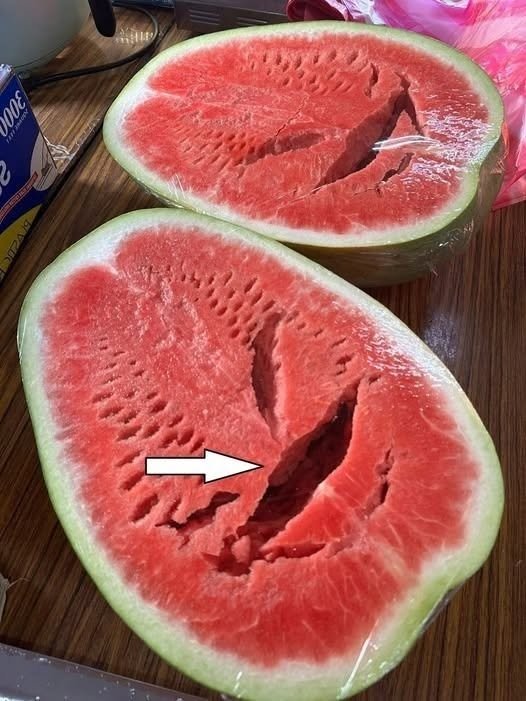
Here’s what cracked watermelons actually mean, based on agricultural science and food safety.
The Truth: It’s Almost Always “Hollow Heart”
What you’re seeing is a physiological disorder called hollow heart, not a sign of poison. It’s perfectly safe to eat.
-
What it looks like: Cracks and crevices in the flesh, sometimes with the pieces separating, leaving a star-shaped or angular hollow cavity.
-
Why it happens: It’s caused by a disruption in the pollination process. When the pollen is poorly distributed or weather conditions (like cold or rain during flowering) interfere with pollination, the fruit’s internal tissue doesn’t develop uniformly. The flesh literally splits as it grows too fast to keep itself together.
-
Is it safe? Yes, absolutely. It is not caused by a pathogen, disease, or chemical. The texture in that area might be slightly mealy or grainy, but the melon is perfectly edible, sweet, and harmless. Seedless watermelon varieties are particularly prone to this.
What About the “Growth Accelerator” Myth?
The videos often claim these internal cracks are proof the fruit was injected with or overdosed on forchlorfenuron (CPPU) , a plant growth regulator used to increase fruit set and size.
Here’s why that’s scientifically invalid for this specific symptom:
-
CPPU doesn’t cause internal cracking. When used excessively, CPPU can cause the fruit to be oddly shaped, have a hollow center (not a cracked, star-burst pattern), or develop a spongy texture. The distinctive “cracked flesh” pattern of hollow heart is a textbook sign of disrupted pollination during early development.
-
Impossible residue logic. Fruit development is a slow, biological process. The “crack” pattern forms over weeks while the melon grows from a golf-ball size. If a chemical caused an instant, violent split, the fruit would rot on the vine long before harvest. You wouldn’t be finding a clean, dry crack in a mature melon.
-
The “exploding watermelon” hoax. Old, unrelated videos of watermelons splitting from an injected dye (for a visual effect) or from fermentation (rotting) are often spliced into these warnings to create fear.
The Only Time You Should Stop Eating It
The internal cracking is not a safety hazard by itself. However, you should use your senses to make a final judgment:
-
Safe to eat: The crack surfaces inside are clean, dry, and have the normal pale-pink or white color of watermelon rind/flesh. The rest of the fruit is firm, sweet-smelling, and juicy.
-
Do not eat: If the cracked areas are mushy, slimy, deeply discolored (brown/black), or have a sour/fermented smell. This is a sign of secondary rot, meaning bacteria or fungi have taken advantage of the natural opening. This can happen to any fruit with an internal cavity if it sat too long, but the hollow heart itself wasn’t the cause.
Bottom line: A watermelon with a star-burst-like crack inside is a victim of bad weather during pollination, not a chemistry experiment. It’s a purely cosmetic issue. You can scrape out the grainy bits around the crack and eat the rest without any fear. Don’t let viral scaremongering waste perfectly good food.